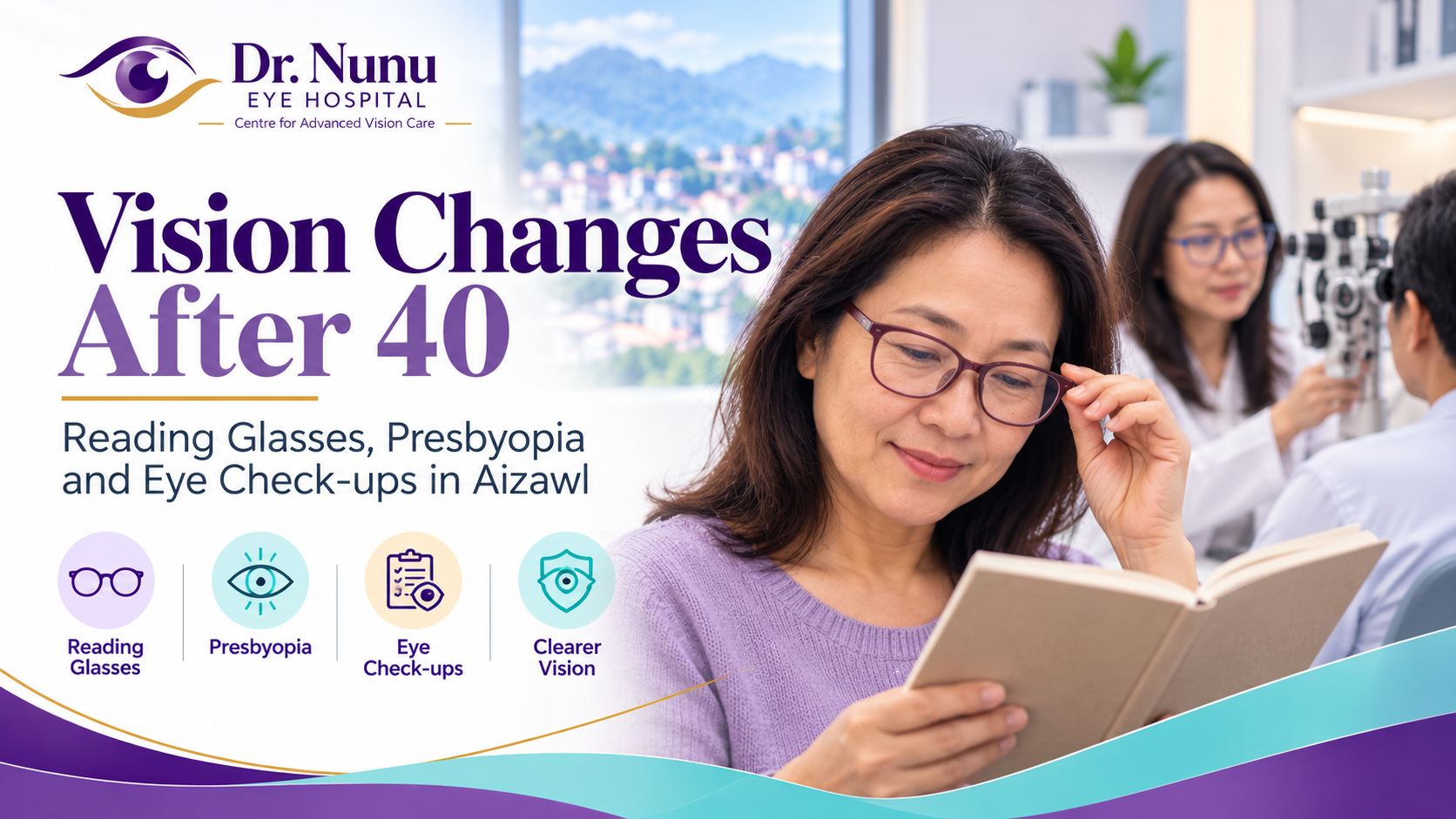
Vision changes after 40 are extremely common. Many adults first notice that restaurant menus, phone messages or medicine labels are harder to read, particularly in dim light. They may hold text farther away, enlarge the font on a screen or remove their distance glasses to see near objects. The usual reason is presbyopia—the normal, age-related loss of the eye’s ability to focus close up.
Presbyopia is not a disease, but not every visual change after 40 should be blamed on ageing. Cataract, glaucoma, diabetic eye disease, retinal problems, dry eye and an outdated spectacle prescription may also affect vision. A comprehensive eye examination can distinguish a routine need for reading glasses from a condition that requires monitoring or treatment. This guide explains options for adults seeking reading glasses and eye check-ups in Aizawl and across Mizoram.
What is presbyopia?
Presbyopia is an age-related focusing problem that makes nearby objects appear blurred. The clear natural lens behind the iris changes shape to focus at different distances. With age, the lens becomes less flexible and the focusing system gradually loses strength. The National Eye Institute explains that presbyopia usually becomes noticeable after about age 45, although timing varies.
Presbyopia eventually affects everyone, including people who have always had excellent distance vision and people who already wear glasses or contact lenses. It progresses gradually and commonly changes through the 40s and 50s before becoming more stable later in life.
Common signs of presbyopia after 40
- small print looks blurred at a normal reading distance;
- you hold a phone, newspaper or label farther away;
- reading is more difficult in dim light;
- your eyes feel tired after close work;
- you develop a brow ache or headache while reading;
- it takes longer to shift focus between near and far objects;
- you need to increase font size or screen brightness;
- you remove your distance glasses to read, particularly if you are short-sighted.
These symptoms are usually gradual and affect both eyes. Sudden or one-sided vision loss is not typical presbyopia and requires prompt assessment.
Presbyopia versus long-sightedness
Presbyopia and hyperopia are different, even though both may blur near vision. Presbyopia results from the ageing focusing system. Hyperopia, or long-sightedness, is a refractive error related to the shape and optical power of the eye. Hyperopia can occur at any age.
A person may have both conditions. Someone with uncorrected hyperopia may notice near-vision difficulty earlier, while a mildly short-sighted person may be able to read by removing distance glasses. Refraction during an eye examination identifies the combination and guides the correct lenses.
Why an eye check-up matters after 40
Buying reading glasses may improve print immediately, but it does not examine eye health. After 40, risks for several eye conditions begin to rise, and many serious diseases cause little or no discomfort in their early stages. The National Eye Institute notes that a dilated examination can detect glaucoma, diabetic retinopathy and age-related macular degeneration before a person recognises vision loss.
An eye examination also checks whether both eyes need the same near correction. Ready-made readers use equal power in both lenses and do not correct astigmatism or differences between eyes. Prescription glasses may therefore provide clearer, more comfortable and better-balanced vision.
What happens during an eye check-up in Aizawl?
Medical and visual history
The doctor asks about near and distance difficulties, changes in one or both eyes, current spectacles, screen and work demands, medicines, previous eye problems and family history. Diabetes, blood pressure, steroid use and a family history of glaucoma are important.
Distance and near visual acuity
Each eye is tested separately. Near testing helps determine how well you can read at your normal working distance. Bring the distance at which you use a phone, desktop monitor, sewing work or other detailed tasks, because the ideal prescription depends on the activity.
Refraction
Refraction measures myopia, hyperopia, astigmatism and the additional near power needed for presbyopia. Your old and new prescriptions may be compared. A large or unexpected change can sometimes point to cataract, blood-sugar fluctuation or another problem.
Eye-pressure and glaucoma assessment
Glaucoma often causes no early symptoms. Assessment may include eye-pressure measurement, optic-nerve examination and, where indicated, visual-field or imaging tests. Pressure alone cannot confirm or exclude glaucoma.
Slit-lamp examination
A microscope is used to examine the eyelids, tear film, cornea, iris and natural lens. This can identify dry eye, inflammation and early cataract that may contribute to glare or fluctuating vision.
Dilated retinal examination
Dilating drops widen the pupils so the doctor can examine the retina, macula and optic nerve. Near vision and light sensitivity may be temporarily affected afterward, so ask whether you should arrange transport and bring sunglasses.
Reading-glasses options
Ready-made readers
Over-the-counter readers can be convenient when presbyopia is the only optical problem and both eyes require similar power. The American Academy of Ophthalmology notes that reading glasses correct close-up vision but recommends determining the needed power through an eye examination.
Ready-made readers do not correct astigmatism, unequal prescriptions or eye alignment issues. A stronger lens is not automatically better: too much power may force a very close working distance and cause discomfort.
Prescription reading glasses
Prescription readers are customised for each eye and can include astigmatism correction. They usually provide a wide, clear near field but must be removed or looked over for distance vision. They are useful for prolonged reading and detailed close work.
Computer or occupational glasses
A desktop monitor is usually farther away than a book or phone. Ordinary readers may therefore be too strong for comfortable computer work. Occupational lenses can be designed for intermediate and near distances, sometimes with a broader computer area than general-purpose progressives.
Bifocals
Bifocals combine distance power in the upper part with a near segment below. The boundary is visible. They provide clearly defined viewing zones, though there is usually no separate intermediate zone unless a specialised design is chosen.
Trifocals
Trifocals add a middle section for intermediate tasks. They can support distance, computer-range and reading vision, but visible lines and image jump may take adjustment.
Progressive lenses
Progressives change gradually from distance through intermediate to near power without a visible line. They allow several viewing distances in one pair, but the clear areas can be narrower and the side zones more distorted. Accurate fitting measurements, appropriate frame selection and adaptation are important.
Contact lenses
Multifocal contact lenses provide more than one focus, while monovision corrects one eye mainly for distance and the other for near. Both require careful fitting and adaptation. Monovision can reduce depth perception or night-vision quality in some people, so a reversible contact-lens trial is useful before considering a permanent surgical approach.
How to choose the right option
The best solution depends on more than age. Discuss:
- whether you need correction for distance as well as near;
- your usual reading and computer distances;
- how much time you drive, particularly at night;
- work that requires precise depth perception;
- previous experience with bifocals or progressives;
- dry-eye or contact-lens symptoms;
- differences in prescription between the eyes;
- cataract, retinal or glaucoma findings.
Some people use separate distance and reading pairs; others prefer progressives for convenience. There is no single lens that is ideal for every patient or task.
Do reading glasses make the eyes weak?
No. Glasses focus light while they are being worn; they do not weaken the eyes or accelerate presbyopia. The need for stronger near correction through the 40s and 50s reflects the normal progression of lens stiffness, not damage caused by glasses. The National Eye Institute states that wearing glasses does not change the eyes or make vision worse.
Avoiding needed correction may instead cause unnecessary eyestrain, headache or poor working posture. A person who suddenly needs much stronger lenses, however, should be examined rather than repeatedly buying higher-power readers.
Can exercises reverse presbyopia?
No eye exercise has been shown to restore the youthful flexibility of the natural lens. Good lighting, larger text, breaks and an appropriate working distance can improve comfort, but they do not reverse the underlying age-related change.
Claims that supplements or exercises permanently eliminate presbyopia should be treated cautiously. Nutritional deficiencies and general health deserve proper medical care, but routine presbyopia is corrected optically or, in selected patients, with specialised procedures.
Are surgical options available?
Some patients ask about reducing dependence on reading glasses through monovision laser correction, corneal procedures or lens-based surgery. These options do not recreate normal youthful focusing and may involve trade-offs in contrast, depth perception, glare or night vision. Suitability depends on corneal health, prescription, age, cataract status and visual priorities.
Presbyopia should not be confused with cataract. Cataract surgery is recommended when a cloudy natural lens meaningfully affects vision and daily activities, not simply because a person needs reading glasses. Anyone considering refractive surgery should have a full examination and a realistic discussion of alternatives and risks.
Other vision changes that may occur after 40
Dry eye
Tear production and eyelid-gland function can change with age. Burning, grittiness and fluctuating clarity—especially during screen use—may be dry-eye symptoms rather than a spectacle problem alone. See our guide to dry-eye treatment in Aizawl and Mizoram.
Cataract
Cataract can cause gradual blur, faded colours, glare, halos, poor night vision and frequent prescription changes. Reading glasses cannot correct blur caused by significant lens clouding. Examination determines whether cataract is present and whether surgery needs discussion.
Glaucoma
Common open-angle glaucoma is usually painless and may damage peripheral vision without early warning. Risk assessment after 40 is important, particularly with a family history, high eye pressure, diabetes, steroid use or suspicious optic nerves.
Diabetic eye disease
Diabetes can cause fluctuating spectacle power when blood sugar changes and may damage retinal blood vessels without early symptoms. People with diabetes need dilated retinal examinations according to their treating doctor’s advice, even when vision seems normal.
Macular and retinal problems
The macula provides detailed central vision. Distortion, a central blurred spot or difficulty recognising faces is not routine presbyopia. New flashes, many floaters or a curtain-like shadow may indicate a retinal tear or detachment and require urgent assessment.
Warning signs that are not normal ageing
Seek urgent eye or emergency medical care for:
- sudden loss, dimming or distortion of vision;
- a curtain, shadow, new flashes or a sudden shower of floaters;
- a painful red eye with blurred vision, halos, nausea or vomiting;
- new double vision or a drooping eyelid;
- eye injury or chemical exposure;
- sudden severe headache with visual or neurological symptoms;
- rapid vision change in one eye;
- new waviness of straight lines or a central blind spot.
Do not assume these symptoms are presbyopia or wait for stronger reading glasses. Our guide to emergency eye care in Aizawl explains additional warning signs.
How often should adults over 40 have an eye examination?
There is no single interval for everyone. Frequency depends on age, findings and risk factors. Adults with diabetes, glaucoma risk, previous eye disease, strong family history, high prescription or concerning symptoms may need more frequent review. Your ophthalmologist can recommend a schedule based on the examination.
Do not delay an appointment until the next routine check if vision changes, glasses stop working as expected or warning symptoms appear.
Practical tips for comfortable near vision
- Use adequate, even lighting without glare.
- Increase text size instead of holding a phone extremely close.
- Keep reading material at the distance used during prescription testing.
- Take regular breaks from prolonged close work and blink fully.
- Position a desktop screen slightly below eye level and at a comfortable distance.
- Keep separate task-specific glasses labelled if their powers differ.
- Clean lenses properly and replace badly scratched lenses.
- Wear appropriate sunglasses outdoors; ordinary reading glasses do not provide eye protection.
Frequently asked questions
At what age do most people need reading glasses?
Many notice difficulty between 40 and 50, but the timing depends on existing prescription, work demands and individual focusing reserve. An examination confirms the cause.
Can I buy readers without an eye test?
They are sold without prescriptions, but an examination checks the correct power, differences between eyes and eye health. Ready-made readers may not suit astigmatism or unequal prescriptions.
Why can I read when I remove my distance glasses?
Short-sighted eyes naturally focus at a closer distance. Removing distance glasses may therefore help near vision, but the comfortable distance depends on the amount of myopia.
Are progressive lenses difficult to use?
Many adapt successfully, while others need adjustments to frame fit, measurements or lens design. Turning the head toward an object and learning the different viewing zones can help.
Does LASIK prevent reading glasses after 40?
No. Standard distance correction does not stop the natural development of presbyopia. Even people with excellent distance vision commonly need near correction as they age.
Eye check-ups and reading-glasses assessment in Aizawl
Adults noticing near blur after 40 should have more than a quick reader-power check. Dr. Lynapawngia Solo at Dr. Nunu Eye Hospital & Research Centre can assess distance and near prescriptions, eye pressure, the natural lens, optic nerve and retina, then discuss reading glasses, occupational lenses or multifocal options suited to daily needs.
To enquire about a presbyopia and eye check-up in Aizawl, call +91 98620 19216. Bring current glasses, a list of medicines and details of the distances used for reading, phones and computers.
Medical note: This article provides general education and does not replace an individual eye examination. Sudden, painful or one-sided visual changes require prompt professional assessment.
Leave a Reply