
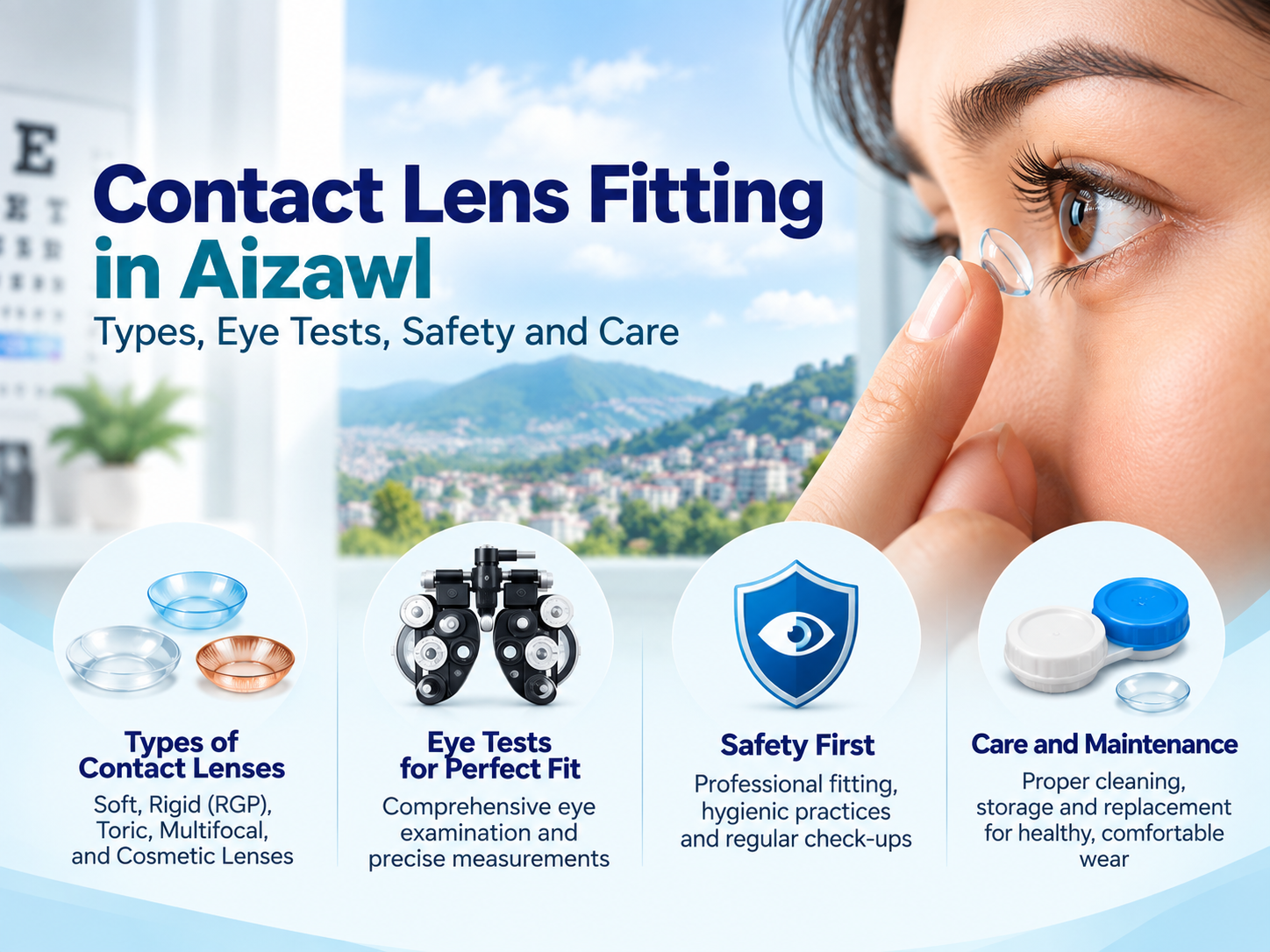
Contact lenses can provide clear vision without spectacles, but they are not one-size-fits-all products. A lens rests directly on the tear film and must match the shape, health and visual needs of each eye. A professional contact lens fitting in Aizawl therefore involves more than checking spectacle power or choosing a lens from a packet.
During a fitting, the eye-care professional examines the front surface of the eyes, measures the cornea, reviews the tear film, discusses work and lifestyle needs, selects a trial lens and checks how it behaves on the eye. Follow-up is important because a lens that feels comfortable for a few minutes may not remain healthy or stable throughout the day.
This guide explains the main types of contact lenses, the eye tests involved, safe wearing habits and warning signs that patients in Aizawl and across Mizoram should know.
Why professional contact lens fitting matters
A spectacle prescription is not the same as a contact lens prescription. Contact lenses sit much closer to the eye, and their effective power may differ, especially with stronger prescriptions. A contact lens specification may also include the lens material or brand, base curve, diameter, replacement schedule and other design details.
Two lenses with the same printed power can differ in shape, thickness, oxygen transmission, edge design and surface properties. These differences can affect comfort, movement, vision and corneal health. Buying a lens based only on spectacle power or changing brands without professional advice can lead to blur, dryness, poor fit or complications.
International safety guidance treats contact lenses, including decorative lenses, as medical devices. The US Food and Drug Administration advises people to use a current prescription and receive regular eye checks. Local prescribing rules may differ, but the clinical principle is relevant everywhere: lenses should be selected and monitored for the individual eye.
Who may benefit from contact lenses?
Contact lenses can correct common refractive errors such as myopia, hyperopia, astigmatism and presbyopia. They may be helpful for sports, social occasions, certain occupations, unequal prescriptions between the eyes or patients who prefer a wider field of view than spectacles provide.
Some people require specialised lenses for irregular corneas, keratoconus, significant astigmatism, corneal scars, dry-eye conditions or after certain eye procedures. Contact lenses can also have therapeutic uses under specialist supervision.
Not everyone is an immediate candidate. Active infection, significant uncontrolled allergy, severe dryness, poor eyelid hygiene, inability to handle lenses safely or difficulty following the care schedule may need attention first. The decision depends on examination findings rather than age or preference alone.
Types considered during contact lens fitting in Aizawl
Soft contact lenses
Soft lenses are flexible and usually adapt quickly to the eye. They are available in different materials, including hydrogel and silicone hydrogel. Silicone hydrogel designs generally allow more oxygen to pass through the lens, but material choice still depends on tear film, comfort, prescription and wearing pattern.
Soft lenses may be designed for daily disposable use or planned replacement over a longer period. Daily disposables are discarded after one day and do not require a storage case or overnight disinfection. Reusable lenses must be cleaned and disinfected exactly as directed and replaced on schedule.
Toric lenses for astigmatism
Toric contact lenses contain different powers in different meridians and use stabilisation features to maintain the correct orientation. The fitter assesses rotation and stability after the lens settles. A lens that rotates excessively may produce fluctuating blur even when its power appears correct.
Multifocal and monovision lenses
Presbyopia commonly affects near focusing from the forties onward. Multifocal contact lenses combine distance and near optics in one design. Monovision uses one eye mainly for distance and the other mainly for near tasks. Both strategies require careful trial and realistic expectations because adaptation, lighting and visual demands vary between patients.
Rigid gas-permeable lenses
Rigid gas-permeable, or RGP, lenses are smaller and retain their shape on the eye. They can provide excellent optics for some patients with high astigmatism or irregular corneas. Initial awareness may be greater than with soft lenses, so adaptation and correct handling are important.
Hybrid and scleral lenses
Hybrid lenses combine a rigid central zone with a soft outer skirt. Scleral lenses are larger rigid lenses that vault over the cornea and rest on the white part of the eye. They create a fluid reservoir and may be considered for selected irregular-cornea or ocular-surface conditions. These are specialised fittings that need detailed measurements, trial evaluation and follow-up.
Coloured and decorative lenses
Cosmetic lenses alter eye colour or appearance, but they still contact the cornea and require proper fitting. The FDA’s decorative-lens guidance warns that improperly fitted lenses can cause scratches, infection and reduced vision. Never share decorative lenses, and avoid sellers who do not require appropriate eye assessment or prescription information.
Eye tests before prescribing contact lenses
Medical and lifestyle history
The fitting begins with questions about previous lens wear, allergies, dryness, eye surgery, medicines and general health. Diabetes, autoimmune disease and some medications may influence the ocular surface. The clinician also asks about screen time, travel, sports, dust exposure, working hours and how many days or hours the lenses will be worn.
Visual acuity and refraction
Visual acuity measures how clearly each eye sees. Refraction identifies the lens power needed to correct myopia, hyperopia and astigmatism. For strong prescriptions, the contact lens power may be adjusted because the lens sits directly on the eye rather than several millimetres in front of it.
Slit-lamp examination
A slit lamp provides a magnified view of the eyelids, lashes, conjunctiva, cornea and tear film. The clinician looks for inflammation, allergy, dryness, scars, abnormal blood vessels and other findings that could affect safe wear. Baseline examination also makes later changes easier to identify.
Corneal measurements
Keratometry measures corneal curvature. Corneal topography may create a more detailed map, especially when the cornea is irregular or a specialised lens is being considered. These measurements help guide the starting lens design, but a successful fit must still be observed directly on the eye.
Tear-film assessment
The tear film supports comfort, lubrication and optical quality. The professional may evaluate tear quantity, tear stability, blinking and the oil glands along the eyelid margins. Dry-eye or eyelid problems may need treatment before or alongside contact lens wear.
Pupil, iris and eyelid assessment
Pupil size can influence glare, halos and multifocal performance. Iris diameter, eyelid position, blink pattern and lid tension may affect lens selection or movement. These details are particularly relevant for specialised, toric or multifocal designs.
What happens during the trial-lens assessment?
After selecting an initial lens, the clinician places it on the eye and allows time for settling. Vision is checked, and additional power may be tested over the trial lens. The lens is viewed with the slit lamp to assess centration, coverage, movement with blinking and response to eye movements.
A soft lens should normally cover the cornea, centre appropriately and move enough to support tear exchange without being excessively loose. A lens that is too tight may initially feel comfortable but move poorly. A loose lens may decentre, cause variable vision or irritate the eyelids. Rigid and scleral lenses are evaluated using criteria appropriate to their design.
Toric lenses are marked so rotation can be measured. Multifocal lenses may require adjustments based on distance, computer and reading tasks. Specialised fittings sometimes require several trials, and this is a normal part of finding the safest and most useful option.
Insertion, removal and handling training
A proper contact lens fitting in Aizawl includes teaching the patient to insert and remove lenses without injuring the eye. The patient should demonstrate the technique independently before taking lenses home.
Wash hands with soap and dry them completely using a clean, lint-free towel. Check that the lens is clean, intact and not inside out. Work over a clean surface and keep fingernails away from the eye. If a lens falls onto an unclean surface, follow the correct cleaning or disposal instructions for that lens type.
Do not use saliva to wet a lens. Do not share lenses, cases or solution. If a lens is torn, chipped or persistently uncomfortable, remove it rather than trying to tolerate it.
Safe schedules after contact lens fitting in Aizawl
Build wearing time according to the schedule given by the eye-care professional. Do not exceed the recommended hours or replacement interval simply because a lens still feels comfortable. A daily disposable lens is used once; it is not designed for cleaning and reuse. Monthly or other reusable lenses should be replaced according to the prescribed interval after opening, not only after a certain number of wears.
Sleeping in lenses increases risk unless a particular lens and schedule have been specifically prescribed for overnight use. Even approved extended wear carries additional risk and requires supervision. When in doubt, remove lenses before sleeping or napping.
Cleaning and storing reusable lenses
Use only the care system recommended for your lens type. The Centers for Disease Control and Prevention advises rubbing and rinsing reusable lenses with appropriate fresh solution and avoiding “topping off” old solution in the case.
Empty the case after each use, rub and rinse it with fresh disinfecting solution, and allow it to air-dry upside down with the caps off on a clean tissue. Replace the case regularly according to professional and manufacturer advice. Saline can rinse lenses in specific routines but does not disinfect them.
Hydrogen-peroxide systems require the special neutralising case supplied with the product and the complete stated neutralisation time. Unneutralised peroxide should never be placed directly in the eye.
Keep contact lenses away from water
Remove lenses before showering, swimming or entering a hot tub. Do not rinse lenses or cases with tap, filtered, bottled or well water. Water can make soft lenses swell or adhere to the eye and can introduce organisms that cause serious corneal infection.
The CDC’s contact-lens water safety advice notes the risk of Acanthamoeba, a microorganism found in many water sources. If lenses are exposed to water, remove them as soon as possible and follow professional or manufacturer guidance about discarding or properly disinfecting them.
Contact lenses, screens and Aizawl’s environment
Long screen sessions reduce blink frequency and may make lenses feel dry. Follow regular screen breaks, blink fully, maintain suitable working distance and use only lubricating drops approved for contact-lens wear. Airflow from fans, heaters or vehicle vents directed at the face may also increase dryness.
Dust, smoke, seasonal allergy and travel can affect comfort. Carry spectacles and a clean lens case when appropriate. Do not keep wearing a painful lens because removing it is inconvenient. Patients travelling within Mizoram should pack adequate prescribed supplies and avoid transferring solution into unlabelled containers.
Warning signs: remove the lenses and seek advice
Remove contact lenses immediately if you develop increasing redness, pain, light sensitivity, discharge, sudden blur, unusual watering or the sensation that something remains in the eye. Do not put the lens back in to see whether symptoms settle.
Contact-lens wear is a recognised risk factor for microbial keratitis, an infection of the cornea that can progress rapidly. Same-day examination is important when pain, redness and reduced vision occur together. Severe pain, rapidly worsening symptoms or major vision loss may require emergency assessment. See our guide to emergency eye care in Aizawl.
Avoid using leftover antibiotic, steroid or redness-relief drops without examination. Steroids can worsen some infections, and symptom-masking drops do not address the cause.
Follow-up after contact lens fitting in Aizawl
Follow-up allows the clinician to check vision, comfort, wearing time, lens condition and the health of the cornea and conjunctiva. Attend even when the lenses feel comfortable, because early changes are not always obvious to the wearer.
Wear the lenses for the requested period before the visit unless they cause pain or other warning symptoms. Bring the lens packaging, case, solution and spectacles. Explain honestly how long the lenses are worn, whether naps occur and how cleaning is performed; accurate information helps the clinician make safer recommendations.
A change in prescription, brand, material, medication, pregnancy, work environment or eye health may require reassessment. Never assume that an old contact lens specification remains appropriate indefinitely.
Common questions about contact lens fitting in Aizawl
Can I use my spectacle power to buy contact lenses?
No. Spectacle power is only one part of the decision. Contact lens power, material, base curve, diameter and design must be assessed on the eye.
Are daily disposable lenses always best?
They reduce care steps and case-related contamination, but suitability, power availability, cost and ocular findings vary. The best lens is the one that meets visual needs while remaining healthy and practical for the patient.
Can I wear lenses if I have dry eyes?
Some patients with dryness can wear selected lenses after tear-film and eyelid assessment, treatment and schedule adjustment. Others may need to delay or limit wear. Self-selecting a “high-water” lens does not guarantee comfort.
Can teenagers wear contact lenses?
Age alone does not determine suitability. Hygiene, motivation, handling ability, parental support and eye health matter. Children and teenagers should be supervised and should always have backup spectacles.
Can coloured lenses be worn without vision power?
Even plano decorative lenses require correct measurement and health assessment because their shape and material still affect the eye.
Book a contact lens assessment in Aizawl
Dr. Lynapawngia Solo at Dr. Nunu Eye Hospital & Research Centre can assess vision, corneal health, tear film and suitability for contact lenses. A structured fitting helps match the lens to the eye and provides the training needed for safer daily use.
To enquire about contact lens fitting in Aizawl, call +91 98620 19216 during available clinic hours. Bring your current spectacles, previous contact lens details and any eye medicines to the appointment.
Medical note: This article provides general education and does not replace an individual eye examination. Lens availability and suitability vary. Remove lenses and seek prompt professional care for pain, marked redness, light sensitivity, discharge or reduced vision.
Leave a Reply