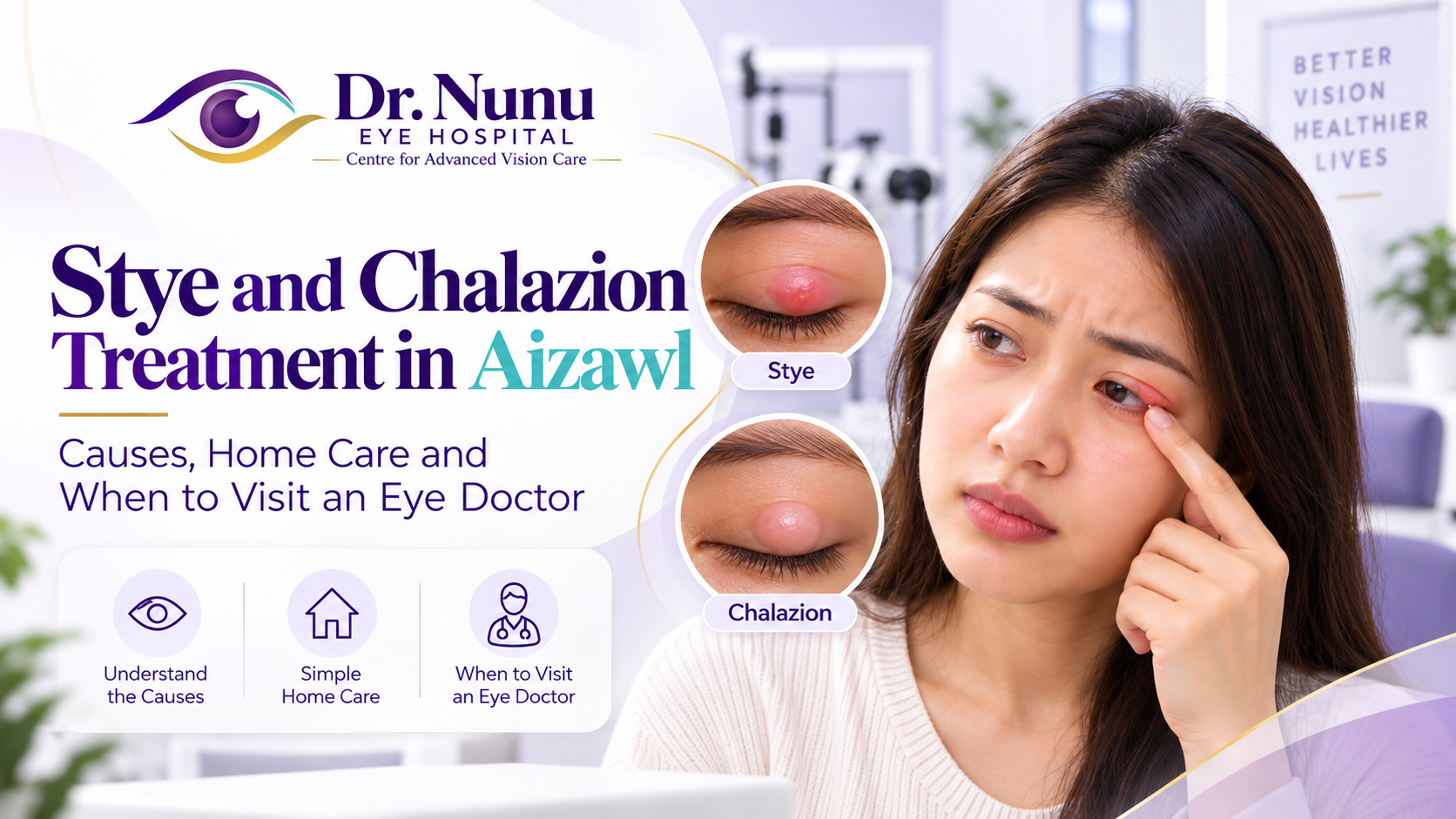
A painful bump or firm lump on the eyelid is often described simply as a “stye,” but not every eyelid lump is the same. A stye is usually a tender infection near an eyelash or an oil gland, while a chalazion is generally a blocked oil gland that forms a firmer and often less painful swelling. Understanding the difference helps patients choose safe home care and recognise when professional treatment is needed.
If you are looking for stye and chalazion treatment in Aizawl, this guide explains common causes, warning signs, warm-compress technique, prevention and the circumstances in which an ophthalmologist should examine the eyelid. Most cases improve without surgery, but persistent, recurrent or rapidly worsening lumps should not be ignored.
What is a stye?
A stye, medically called a hordeolum, is a localised infection or inflamed blockage involving an eyelash follicle or an eyelid oil gland. An external stye develops near the base of an eyelash and may form a small yellow point. An internal stye forms deeper inside the eyelid and can cause more diffuse tenderness and swelling.
Typical features include:
- a painful or tender red lump;
- localised eyelid swelling;
- a gritty or irritated feeling;
- watering of the eye;
- crusting near the eyelashes;
- a small pus-filled point in some cases.
A stye is not the same as general conjunctivitis. Conjunctivitis usually causes widespread redness, watering or discharge without a single tender eyelid lump. Read our guide to conjunctivitis treatment in Aizawl and Mizoram for more information.
What is a chalazion?
A chalazion is a lump caused by blockage and inflammation of a meibomian gland, one of the small oil-producing glands inside the eyelid. The trapped oily material triggers inflammation and gradually forms a rounded swelling.
A chalazion often begins with mild tenderness but usually becomes firm and relatively painless. It can occur on the upper or lower eyelid. A large chalazion may press on the cornea and temporarily blur or distort vision.
The Government of Mizoram’s Standard Treatment Guidelines for chalazion note that some chalazia resolve spontaneously and that persistent cases may require treatment selected by a clinician.
Stye versus chalazion: how are they different?
The two conditions can look similar, particularly in the early stage. The following differences are useful but do not replace an examination:
- Pain: a stye is commonly sore and tender; a chalazion is often painless after the initial inflammation settles.
- Location: an external stye usually appears at the eyelash edge; a chalazion frequently feels deeper within the lid.
- Appearance: a stye may form a small yellow centre; a chalazion is often a smooth, firm lump.
- Cause: a stye generally involves infection or acute inflammation; a chalazion results mainly from a blocked oil gland.
- Course: a stye may drain and improve over days; a chalazion may persist for several weeks or longer.
Some styes evolve into chalazia after the acute infection settles but the gland remains blocked.
What causes styes and chalazia?
Blocked eyelid oil glands
Meibomian glands release oils that help prevent tears from evaporating. Thickened secretions, inflammation or blockage can trap oil within the gland and produce a chalazion.
Bacteria around the eyelashes
Styes commonly occur when bacteria enter an eyelash follicle or oil gland. Touching or rubbing the eyes with unwashed hands can transfer bacteria to the eyelid margin.
Blepharitis
Blepharitis causes chronic inflammation, crusting and irritation along the eyelid edges. It can interfere with oil-gland function and increase the likelihood of recurrent styes or chalazia.
Rosacea and oily skin conditions
People with rosacea, seborrhoeic dermatitis or meibomian gland dysfunction may have thicker gland secretions and repeated eyelid inflammation.
Eye makeup and contact-lens hygiene
Sleeping in eye makeup, using expired cosmetics, sharing makeup or handling contact lenses without clean hands can irritate the eyelids and increase infection risk. Makeup applicators may collect oils and bacteria over time.
Diabetes and other health factors
Diabetes can increase susceptibility to infections and may affect healing. A clinician may consider general health when eyelid infections are frequent, severe or slow to resolve.
Safe home care for a stye or chalazion
Use a warm compress correctly
Warm compresses are the main home treatment for uncomplicated styes and chalazia. Warmth can soften thickened oils and encourage a blocked gland to open naturally.
- Wash your hands thoroughly.
- Soak a clean washcloth in comfortably warm—not scalding—water.
- Wring out excess water and place the cloth over the closed eyelid.
- Keep it in place for about 10 minutes, reheating the cloth as it cools.
- Repeat several times a day as advised by your eye doctor.
The compress should never be hot enough to burn the delicate eyelid skin. Use a fresh, clean cloth and do not share it with another person.
Gentle eyelid massage
After warming the lid, a clinician may recommend very gentle massage toward the eyelashes to help gland contents drain. Do not massage a severely painful, very red or rapidly spreading infection without medical advice. Never use sharp tools or fingernails on the lump.
Keep the eyelids clean
Wash away crusting gently using the eyelid-cleaning method recommended by your eye doctor. People with blepharitis may require a longer-term lid-hygiene routine even after the lump resolves.
Pause contact lenses and eye makeup
Avoid contact lenses and eye makeup until the eyelid is comfortable and healed. Continuing to wear lenses can add irritation and handling may spread bacteria. Replace potentially contaminated eye cosmetics rather than reusing them after the infection resolves.
Do not squeeze or pop the lump
Squeezing can push infection into surrounding eyelid tissue and increase swelling. Do not pierce the lump, pull out an eyelash or attempt drainage at home. Drainage should be performed only by an appropriately trained clinician using sterile equipment.
The NHS guidance on styes recommends warm compresses and specifically warns against bursting a stye because doing so can spread infection.
What should you avoid?
- Do not apply toothpaste, garlic, turmeric paste, saliva or unverified herbal preparations near the eye.
- Do not use leftover antibiotic or steroid eye drops.
- Do not share towels, cosmetics or contact-lens equipment.
- Do not rub the eyelid repeatedly.
- Do not continue contact-lens wear when the eye or eyelid is inflamed.
- Do not delay care if redness or swelling is spreading.
Eye medicines are not interchangeable. Steroid-containing drops or ointments can worsen some infections and raise eye pressure, so they should be used only after examination and prescription.
When should you visit an eye doctor in Aizawl?
Arrange an ophthalmic examination if:
- the lump does not begin improving with appropriate home care;
- it persists for several weeks;
- pain or swelling is significant;
- the entire eyelid becomes swollen;
- the eye itself becomes red or painful;
- there is pus or heavy discharge;
- vision becomes blurred or the lump presses on the eye;
- the swelling keeps returning in the same location;
- multiple lumps develop repeatedly;
- the patient has diabetes or reduced immunity;
- a child cannot open the eye comfortably;
- you are unsure whether the lump is a stye, chalazion or another eyelid condition.
A recurrent lump in exactly the same place, loss of eyelashes, unusual bleeding, irregular thickening or a lesion that does not heal requires careful examination. Although uncommon, some eyelid tumours can resemble a persistent chalazion. The doctor may recommend biopsy when a lesion is atypical or repeatedly returns.
Symptoms that need urgent attention
Seek urgent care if eyelid redness and swelling spread rapidly, the eye becomes difficult to move, vision falls, the eye protrudes, pain is severe, or fever and general illness develop. These features can suggest infection extending beyond a simple stye.
Sudden vision loss, chemical exposure, penetrating injury or severe eye pain should be treated as an emergency. See our overview of urgent eye symptoms in Aizawl.
How an eye doctor examines an eyelid lump
The ophthalmologist will ask when the lump started, whether it is painful, whether similar lumps have occurred and what treatments have been tried. Contact-lens habits, eye makeup, skin conditions, diabetes and symptoms of blepharitis may be relevant.
The eyelid is examined from the outside and may be gently turned to inspect its inner surface. A slit-lamp microscope helps evaluate the eyelashes, oil-gland openings, conjunctiva, cornea and the rest of the eye. Vision is checked, particularly if the lump is large or close to the visual axis.
Additional laboratory tests are rarely needed for a straightforward first episode. Recurrent or atypical lesions may need closer assessment or tissue examination.
Medical treatment for a stye
Many styes drain and settle with warmth and hygiene. If infection is significant, the ophthalmologist may prescribe an antibiotic ointment, drops or oral medicine depending on the findings. Antibiotics are not automatically required for every lump.
A very painful internal stye or a lesion that fails to drain may require a small procedure. This should not be attempted at home. Treatment choice depends on the location of the infection, surrounding swelling and the patient’s health.
Medical treatment for a chalazion
Continued conservative treatment
Small chalazia often improve gradually with warm compresses, lid massage and management of underlying blepharitis. Resolution can take weeks, and the lump may become smaller before disappearing.
Steroid injection
For selected chalazia, an ophthalmologist may inject corticosteroid into or near the lesion. This can reduce inflammation, but it has potential risks including skin-colour change and is not suitable for every patient or every location.
Incision and curettage
A persistent or visually significant chalazion may be drained through a small incision, usually from the inner eyelid surface. Local anaesthetic is commonly used in adults. Children may require different anaesthesia planning depending on age and cooperation.
The American Academy of Ophthalmology’s patient guidance explains that surgery may be considered when a stye or chalazion affects vision or fails to resolve, while recurrent lesions may require biopsy.
Styes and chalazia in children
Children frequently touch or rub their eyes, and they may find warm-compress treatment difficult. A parent should supervise and make sure the cloth is comfortably warm. Never force a child to tolerate excessive heat or firm pressure.
Seek medical advice if a child has marked swelling, fever, spreading redness, vision complaints, repeated chalazia or a lump that persists. A large chalazion can sometimes change the corneal shape and blur vision, which is important during visual development.
Why do eyelid lumps keep returning?
Recurrence may be related to chronic blepharitis, meibomian gland dysfunction, rosacea, incomplete lid hygiene, eye rubbing or reuse of contaminated cosmetics. Treatment may therefore include a preventive eyelid-care routine rather than focusing only on each individual lump.
An ophthalmologist can look for signs of gland dysfunction and advise on suitable lid cleaning, warm compress frequency and treatment of associated dry eye. Read more about dry-eye symptoms and treatment in Aizawl.
How to reduce the risk of future styes and chalazia
- Wash hands before touching the eyes or handling contact lenses.
- Remove eye makeup completely before sleeping.
- Replace expired mascara, eyeliner and applicators.
- Do not share towels, cosmetics or contact-lens accessories.
- Follow lens-cleaning and replacement instructions.
- Manage blepharitis and rosacea consistently.
- Avoid rubbing the eyes.
- Use warm compresses as advised if oil-gland blockage is recurrent.
- Keep diabetes and other medical conditions appropriately managed.
Frequently asked questions
Is a stye contagious?
A stye itself is not usually spread like a cold, but bacteria can be transferred through hands, towels or cosmetics. Good hygiene and avoiding shared personal items reduce this risk.
Can I go to work or school with a stye?
Many people can continue normal activities if they feel well, but should avoid sharing towels, rubbing the eye, makeup and contact lenses. Significant pain, discharge or spreading swelling warrants medical advice.
How long does a chalazion take to disappear?
Some improve over several weeks, while others last longer. Size, duration, gland blockage and underlying lid inflammation affect recovery. A persistent lump should be examined rather than treated indefinitely at home.
Do antibiotics cure a chalazion?
A chalazion is primarily inflammatory and caused by blocked oil, so antibiotics do not automatically remove it. They may be prescribed when infection or associated blepharitis is present.
Can a chalazion affect eyesight?
A large lesion can press on the cornea and cause temporary blur or astigmatism. Vision usually improves when pressure resolves, but any visual change should be assessed.
Should I use a hot compress?
Use comfortably warm—not hot—water. Excess heat can burn eyelid skin. Test the temperature carefully, especially for children or people with reduced skin sensation.
Can I wear contact lenses during treatment?
It is safer to stop lens wear until the eyelid and eye have healed and any prescribed treatment is complete. Ask your eye doctor when it is appropriate to restart.
Stye and chalazion treatment in Aizawl
Dr. Lynapawngia Solo at Dr. Nunu Eye Hospital & Research Centre can assess eyelid lumps, blepharitis and related eye irritation. The examination helps distinguish a stye or chalazion from other conditions and determines whether continued home care, medication, a procedure or further testing is appropriate.
To enquire about stye or chalazion treatment in Aizawl, call +91 98620 19216. Mention severe pain, spreading swelling, fever or vision changes when booking so the clinic can advise on urgency.
Medical note: This article provides general information and does not replace an eye examination. Do not squeeze, pierce or attempt to drain an eyelid lump yourself. Seek urgent care for reduced vision, severe pain, rapidly spreading swelling, fever or difficulty moving the eye.