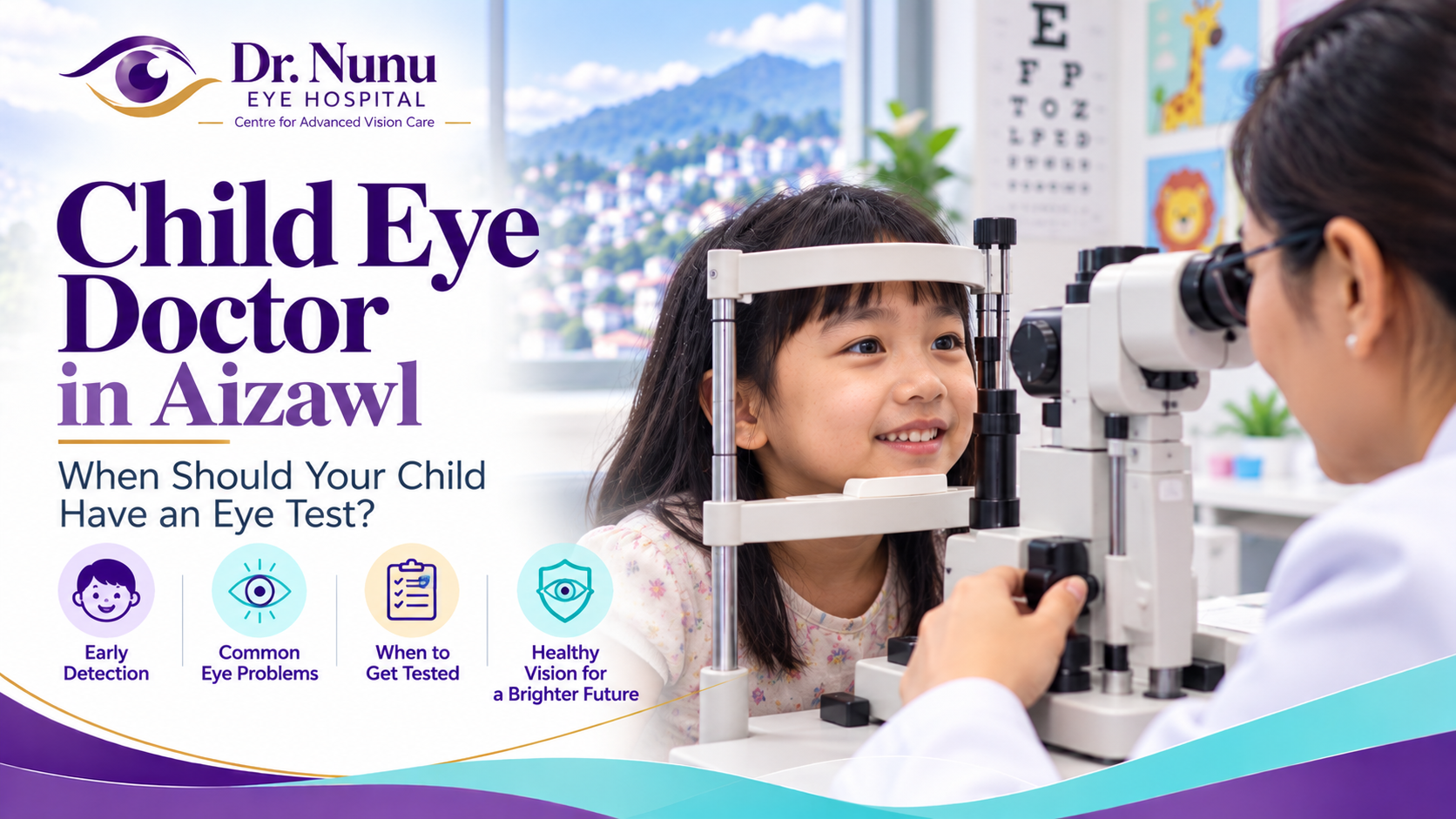
Parents searching for a child eye doctor in Aizawl often want to know when an examination is necessary. Children do not always realise or explain that they cannot see clearly. A child may assume that blurred vision is normal, use one eye more than the other or quietly adapt by sitting closer to the board. This is why parents should not wait for a child to complain before arranging an eye examination.
A child eye doctor in Aizawl can assess much more than spectacle power. A complete examination can check how the eyes focus, move and work together, as well as the health of the cornea, lens, retina and optic nerve. Early assessment is especially important because clear, balanced vision supports visual development, classroom learning, reading, coordination and confidence.
This guide explains when children should have an eye test, which warning signs parents and teachers should notice, what happens during an examination and why early treatment of conditions such as lazy eye, squint and childhood myopia can make a meaningful difference.
Why children need eye examinations
A school vision screening or the ability to read large letters does not rule out every eye problem. A child can have reasonably clear vision in one eye and poor vision in the other without obvious symptoms. Children may also pass a basic distance-vision screening while experiencing farsightedness, focusing difficulty, eye-teaming problems or an eye-health condition.
The American Academy of Ophthalmology guidance on children’s vision screening supports timely screening so problems can be detected and referred for examination when needed. Vision develops rapidly during childhood. If one eye sends a consistently weaker image to the brain, the brain may begin to rely on the stronger eye. This can lead to amblyopia, commonly called lazy eye. Treatment is generally more effective when the problem is detected while the visual system is still developing.
When should you visit a child eye doctor in Aizawl?
The right schedule depends on age, symptoms, family history and medical risk. Routine checks performed by a paediatrician are important, but they do not always replace a comprehensive examination by an ophthalmologist when a concern is present.
Newborn eye checks and referral to a child eye doctor
A newborn’s eyes are usually checked soon after birth for normal appearance and the red reflex. Babies born prematurely or with a low birth weight may require specialised retinal screening according to neonatal guidance. A baby should be examined promptly if the pupil appears white, the eyes are unusually large or cloudy, there is persistent discharge, an eyelid droops, or the eyes do not appear to move normally.
Infancy
Parents should watch whether the baby makes eye contact, follows faces or objects, and uses both eyes together. Brief misalignment can occur in very young infants, but a consistently turned eye or an eye that frequently drifts after the early months needs assessment. Excessive tearing, light sensitivity, an abnormal pupil appearance or unusual eye movements should not be ignored.
Eye tests for toddlers and preschool children in Aizawl
Children may not be able to name letters, but their vision can still be assessed using matching symbols, pictures, lights and age-appropriate methods. An examination during the preschool years can detect unequal spectacle power, squint and amblyopia before formal schooling becomes demanding.
Child eye test in Aizawl before starting school
A complete eye check before school is valuable even when no complaint is obvious. This establishes whether both eyes see clearly and work together. If a screening identifies a concern, or the child cannot complete it reliably, arrange a comprehensive examination rather than assuming the result is normal.
During the school years
Children should be re-examined when symptoms arise, when a teacher notices difficulty, or according to the schedule advised by the eye doctor. A child who already wears spectacles, has progressive myopia, squint, amblyopia, diabetes or another eye condition will require regular follow-up.
Signs your child should see a child eye doctor in Aizawl
Book an appointment with a child eye doctor in Aizawl if you notice any of the following:
- sitting very close to the television or classroom board;
- holding books or a phone unusually close;
- squinting, closing or covering one eye;
- frequent blinking, rubbing or watering of the eyes;
- headaches or eye strain after reading;
- losing place while reading or avoiding near work;
- tilting or turning the head to see;
- one eye turning inward, outward, upward or downward;
- difficulty recognising people or objects at a distance;
- frequent tripping, poor hand-eye coordination or difficulty catching a ball;
- a sudden decline in school performance;
- complaints of double vision, blur, eye pain or light sensitivity.
These signs do not prove that an eye disorder is present, but they justify assessment. Reading and learning difficulties can have several causes; an eye test helps determine whether vision is contributing.
Eye symptoms that require urgent treatment
Some symptoms should not wait for a routine appointment. Seek urgent eye care for a chemical splash, sharp-object injury, embedded foreign body, sudden loss of vision, severe eye pain, marked light sensitivity, a white spot on the cornea, swelling with fever, blood inside the eye or a new white reflection in the pupil.
After a chemical exposure, begin rinsing the eye immediately with plenty of clean water and seek emergency care. Do not wait to identify the chemical and do not put unprescribed medicine in the eye. For other injuries, avoid rubbing or pressing the eye.
Our guide to emergency eye care in Aizawl explains additional warning signs.
Common conditions assessed by a child eye doctor in Aizawl
Refractive errors
Myopia, hyperopia and astigmatism affect the way light focuses in the eye. Myopia makes distant objects blurry, while significant hyperopia can make near work difficult or cause strain. Astigmatism can blur vision at different distances. Properly prescribed spectacles give the child a clear image and support normal visual development.
Childhood myopia
Myopia often begins during the school years and may progress as the child grows. A child may move closer to the board, narrow the eyes to see or avoid distance activities. Regular measurements help the doctor track change and discuss suitable management. Read more about childhood myopia in Aizawl and Mizoram.
Squint or strabismus
Squint means the eyes are not consistently aligned. One eye may turn inward, outward, upward or downward. The misalignment can be constant or intermittent and may be more visible when the child is tired. Squint can affect binocular vision and may cause amblyopia, so it should not be dismissed as something the child will automatically outgrow.
Lazy eye or amblyopia
Amblyopia is reduced vision caused by abnormal visual development. Common causes include squint, unequal spectacle power between the two eyes, or an obstruction such as cataract. A child may function normally using the stronger eye, which is why testing each eye separately matters. Treatment may include spectacles, patching, drops or management of the underlying condition, depending on the diagnosis.
Parents can read our detailed guide to squint and lazy-eye treatment in Aizawl.
Eye allergy
Itching, redness, watering and frequent rubbing may indicate allergy. Rubbing can worsen irritation, and persistent symptoms should be examined. Do not use steroid eyedrops without medical supervision because inappropriate use can cause serious complications.
Blocked tear duct and watering
Some babies have persistent watering or discharge because tears do not drain normally. Many cases improve with growth, but examination is important when symptoms are severe, recurrent or associated with redness, swelling, pain or fever.
Eye infections
Redness and discharge can result from several conditions. Not every red eye is conjunctivitis, and antibiotics are not appropriate for every case. Children should avoid sharing towels, cosmetics or eyedrops, and persistent pain or reduced vision requires prompt assessment.
Eye tests performed by a child eye doctor in Aizawl
An examination with a child eye doctor in Aizawl is adapted to the child’s age and ability. The child does not need to know the alphabet or give perfect verbal answers.
Medical and family history
The doctor may ask about birth history, premature delivery, developmental milestones, medicines, general health, previous eye treatment and family history of high spectacle power, squint, lazy eye, childhood cataract, glaucoma or inherited eye disease.
Vision testing by a child eye doctor in Aizawl
Each eye is tested separately using letters, numbers, matching symbols, pictures or other age-appropriate targets. Testing each eye independently is essential because one strong eye can hide a problem in the other.
Eye alignment and movement
The doctor checks whether the eyes are straight, move fully in every direction and work together. Cover tests and light-reflex tests can reveal an intermittent or small squint that may not be obvious in photographs.
Focusing and spectacle-power assessment
Children can accommodate strongly, which may hide their true spectacle power. Dilating drops may therefore be recommended to relax focusing and allow an accurate measurement. The drops can temporarily blur near vision and increase sensitivity to light.
Eye-health examination
The front and back of the eyes are examined to assess the cornea, lens, retina and optic nerve. Additional tests are advised only when the findings or medical history make them necessary.
Preparing for a child eye test in Aizawl
- Describe the visit positively and avoid suggesting that the examination will hurt.
- Bring the child’s current spectacles and any previous prescriptions or reports.
- List medicines, allergies and relevant medical conditions.
- Bring feedback from the teacher if classroom difficulty has been noticed.
- Allow extra time if dilating drops may be required.
- Bring sunglasses or a hat because light may feel bright after dilation.
A tired, hungry or frightened child may find testing difficult. When possible, choose an appointment time that suits the child’s usual routine.
Screen-time advice from a child eye doctor in Aizawl
Long periods of close work can cause tired eyes, dryness, headaches and temporary blur. Screen use also reduces time spent outdoors. Parents can encourage regular breaks, comfortable working distance, good lighting and daily outdoor activity. A useful habit is to look away into the distance regularly rather than staring continuously at a near screen.
Screen habits do not explain every symptom. A child who repeatedly moves close to screens, squints or complains of blur still needs an eye examination.
How often should your child revisit an eye doctor in Aizawl?
The interval depends on age, prescription and diagnosis. Growing children can experience changes in spectacle power, and frames can become loose or poorly positioned. Children being treated for amblyopia or squint may require more frequent reviews to assess progress and adjust treatment safely.
Parents should not change patching hours, stop prescribed drops or purchase a new prescription based only on an automated test. Follow the plan provided by the treating ophthalmologist.
Frequently asked questions for a child eye doctor in Aizawl
My child has no complaints. Is an eye test still needed?
Yes. Children may not recognise blur, and one healthy eye can compensate for a weaker eye. Age-appropriate screening and examination can identify problems before they affect learning or visual development.
Can a child’s eyes be tested before they can read?
Yes. Eye doctors use pictures, matching symbols, lights, fixation targets and objective measurements. Reading letters is not required for a meaningful examination.
Will wearing spectacles make a child’s eyes weaker?
No. Correct spectacles provide the clear image the child needs. Avoiding a necessary prescription can leave the child struggling and, in some cases, interfere with visual development.
Can a child outgrow squint?
Parents should not assume so. Some apparent misalignment is caused by facial features, but true squint requires assessment. The treatment and timing depend on its type, cause and effect on vision.
Should siblings be checked?
A family history of squint, amblyopia, high spectacle power or inherited eye disease can increase concern. Tell the doctor about affected relatives and ask whether siblings should be examined.
Where can I find a child eye doctor in Aizawl?
Parents in Aizawl and elsewhere in Mizoram can contact Dr. Nunu Eye Hospital & Research Centre for an age-appropriate eye assessment. Dr. Lynapawngia Solo can evaluate vision, spectacle power, eye alignment and eye health and explain whether treatment or follow-up is required.
Book a child eye doctor in Aizawl
Do not wait until blurred vision becomes obvious or school performance declines. Arrange an examination if your child has never had both eyes tested separately, has symptoms, fails a screening, has a family history of childhood eye problems or already uses spectacles.
To book an appointment with a child eye doctor in Aizawl at Dr. Nunu Eye Hospital & Research Centre, call +91 98620 19216.
This article provides general information and does not replace an examination or personalised medical advice. The timing of eye tests and treatment should be decided according to each child’s age, symptoms, medical history and examination findings.