
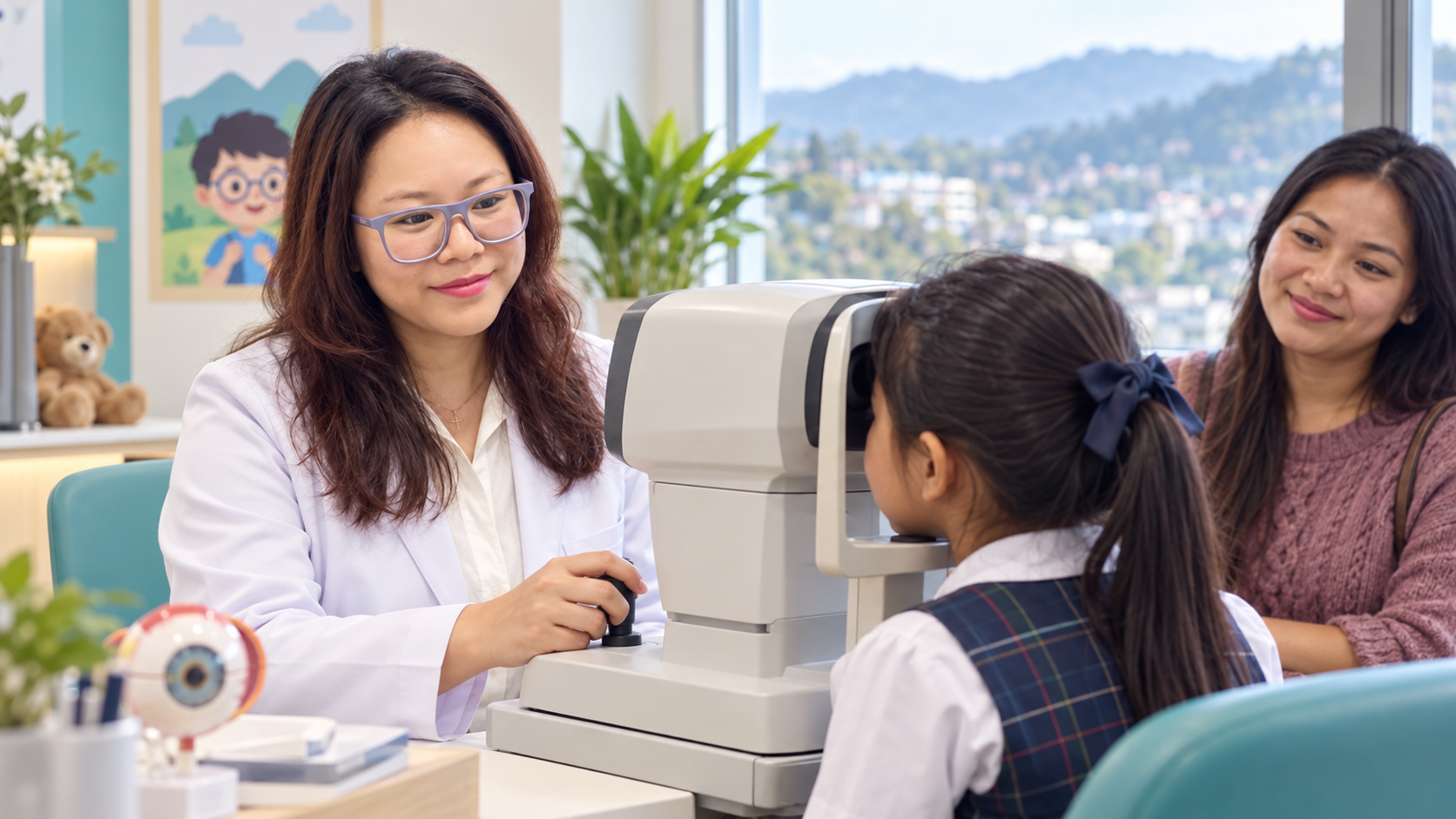
When a child can read a book clearly but struggles to see the classroom board, recognise a distant face, or follow a ball across a playground, myopia may be the reason. Myopia, also called short-sightedness or nearsightedness, is common in school-age children and can progress as the eyes grow. Families looking for childhood myopia treatment in Aizawl should begin with a complete eye assessment rather than relying only on a quick spectacle check.
This guide explains the signs of childhood myopia, why prescriptions change, what happens during an eye examination, and how parents can support healthy visual habits. It also discusses treatment and myopia-control options that an ophthalmologist may consider. The information is educational and cannot replace an individual examination.
What is childhood myopia?
In a normally focused eye, incoming light is brought to a clear focus on the retina, the light-sensitive tissue at the back of the eye. In myopia, the eye is usually too long from front to back, or the cornea and lens focus light too strongly. Light comes to a focus in front of the retina, making distant objects appear blurred while nearby work may remain clear.
Myopia often begins during the school years. It may increase gradually through childhood and adolescence because the eye is still developing. The National Eye Institute notes that myopia commonly starts between ages six and fourteen and may worsen into the early twenties. A family history can raise risk, but children without myopic parents can also develop it.
Myopia is measured in dioptres and written with a minus sign on a spectacle prescription. A more negative number generally indicates stronger short-sightedness. Parents should avoid comparing numbers without professional guidance: the child’s age, rate of change, eye coordination, and retinal health also matter.
Signs parents and teachers may notice
Children do not always realise that their distance vision is blurred. They may assume everyone sees the same way or compensate by moving closer. Watch for patterns rather than waiting for a clear complaint.
- Squinting to see the school board, television, road signs, or distant faces
- Sitting unusually close to a screen or moving nearer to the front of the classroom
- Holding books or devices close to the face
- Complaining of tired eyes, headaches, or difficulty concentrating after visual tasks
- Rubbing the eyes or blinking frequently
- Losing interest in activities that depend on clear distance vision
- Making mistakes when copying from the board despite understanding the lesson
- A noticeable decline in school performance or confidence
These behaviours can have other causes, including astigmatism, focusing or eye-coordination problems, dry eye, or a general health issue. An eye examination is the appropriate way to identify the cause.
Why early detection matters
Clear vision supports classroom learning, sport, mobility, and social confidence. An uncorrected prescription can make daily tasks unnecessarily difficult. Detecting myopia also allows the eye-care team to track whether it is progressing slowly or rapidly.
Higher levels of myopia are associated with a greater lifetime risk of retinal detachment, myopic macular changes, glaucoma, and cataract. This does not mean a child with myopia will develop these problems. It explains why eye specialists increasingly consider both clear vision now and the long-term goal of limiting progression where appropriate.
Vision screening at school is helpful, but it is not identical to a comprehensive clinical assessment. A child who fails screening, repeatedly squints, or has a strong family history should receive a targeted eye examination. A child can also pass a basic check and later develop a changing prescription.
Childhood myopia treatment Aizawl: the eye examination
A paediatric eye assessment is adapted to the child’s age and ability to respond. The visit is generally painless. Parents can help by bringing previous prescriptions, spectacles, school screening notes, and information about family eye history.
Visual-acuity testing
The team measures how clearly each eye sees separately and together. Letter charts, numbers, matching symbols, or pictures may be used depending on the child’s age. Testing each eye individually matters because one eye may see differently from the other.
Refraction
Refraction determines the lens power required for clear vision. Children can focus strongly during testing, which may temporarily make the prescription appear more myopic. For this reason, the ophthalmologist may use cycloplegic drops to relax focusing and obtain a more accurate measurement. The drops can cause temporary blur for near work and sensitivity to bright light.
Eye alignment and focusing
The examination may check how the eyes move, align, and work together. Symptoms such as headaches, skipping lines, or difficulty sustaining near work are not always explained by myopia alone.
Eye-health examination
The doctor examines the front and back of the eyes. Depending on the child’s findings, dilation may be recommended to view the retina and optic nerve. Children with high myopia or concerning symptoms may need particular attention to retinal health.
Measurements for progression monitoring
Where available and clinically indicated, the ophthalmologist may document corneal shape or the axial length of the eye. Comparing consistent measurements over time can help assess progression and guide discussions about myopia management.
Glasses for childhood myopia
Properly prescribed spectacles are the most common way to give a myopic child clear distance vision. Wearing the correct glasses does not make the eyes “lazy” or cause myopia simply because the child becomes accustomed to clarity. The prescribed wearing schedule depends on age, power, symptoms, and visual needs.
Frames should fit securely without slipping, pressing behind the ears, or sitting too far from the eyes. Lenses for active children should be durable and suitable for daily use. If a child looks over the top of the frame, removes the glasses frequently, or still cannot see the board, arrange a review rather than assuming the child is being difficult.
Prescriptions can change as children grow. Keep follow-up appointments and replace badly scratched, bent, or poorly fitting spectacles. A spare pair may be useful for families travelling between Aizawl and other parts of Mizoram.
Can myopia progression be slowed?
Standard glasses correct blurred vision but do not necessarily slow the underlying growth of a myopic eye. For some children, an ophthalmologist may discuss a myopia-control plan. Options can include specially designed spectacle lenses, selected multifocal or dual-focus contact lenses, orthokeratology lenses worn overnight, or low-dose atropine eye drops.
Each option has advantages, limitations, age considerations, costs, and safety requirements. Contact-lens approaches demand excellent hygiene and responsible handling because misuse can cause infection. Atropine is a medicine and must be prescribed and monitored. Orthokeratology is not suitable for every child and requires careful fitting and follow-up.
No method can promise to stop progression completely. The appropriate choice depends on the child’s prescription, age, progression pattern, corneal and retinal health, maturity, family circumstances, and ability to attend regular reviews. Families seeking childhood myopia treatment in Aizawl should discuss realistic goals and monitoring with an ophthalmologist before choosing a method.
Outdoor time, screens, and near work
Research reviewed by major eye-health organisations indicates that children who spend more time outdoors are less likely to become myopic. Outdoor activity should be safe, age-appropriate, and balanced with local weather, school responsibilities, and the child’s general health. It is a supportive habit, not a substitute for spectacles or medical care.
Long periods of uninterrupted near work may contribute to visual strain and are associated with myopia risk. Encourage children to take regular breaks from books, phones, tablets, and computers. During a break, they can look across a room or outdoors, blink normally, change posture, and move around.
Keep reading material at a comfortable distance, provide good lighting, and avoid using a phone very close to the face. Screen limits should consider homework as well as entertainment. Parents can model the same habits instead of making eye care feel like punishment.
Practical habits for families in Mizoram
- Arrange an eye check when a child squints or reports blurred distance vision.
- Tell the teacher about the prescription and request suitable seating until glasses are ready.
- Encourage regular outdoor play when conditions are safe.
- Build short visual breaks into study and device time.
- Keep spectacles clean, properly aligned, and stored in a protective case.
- Record prescription dates and attend the recommended review interval.
- Seek prompt care after eye injury or sudden visual change.
Families travelling from outside Aizawl can bring the child’s old glasses and reports so the ophthalmologist can compare changes. If drops are likely to be used, allow enough time for the visit and carry sunglasses for comfort afterward.
When does a child need urgent eye care?
Routine myopia usually changes gradually, but certain symptoms should not wait for a standard appointment. Seek urgent assessment for sudden loss of vision, a dark curtain or shadow, many new floaters, flashes of light, significant eye pain, marked redness, a chemical exposure, or an eye injury. Double vision, a newly turned eye, or a white reflex seen in photographs also deserves prompt professional evaluation.
Helping a child at school
A clear prescription works best when the child can use it consistently. Tell the class teacher that the child has myopia and confirm whether the glasses should be worn throughout the school day. Until the spectacles are ready, a seat nearer the board may reduce difficulty, but seating is not a replacement for correction.
Ask the child whether writing on the board is clear from the usual seat and whether glare makes it harder to see. Teachers can watch for copying errors, squinting, loss of attention during board work, or frequent requests to move closer. These observations can be useful at follow-up appointments.
Children sometimes avoid glasses because they worry about teasing or feel different from classmates. Let the child help choose a comfortable frame, explain that glasses are a tool for learning and play, and address bullying promptly with the school. Positive support is more effective than criticism. Keep the latest prescription and eye report available when changing schools or moving between districts in Mizoram.
Frequently asked questions
Will my child outgrow myopia?
Myopia often progresses while the child grows and commonly stabilises later, but the pattern varies. Regular measurements are more reliable than trying to predict the outcome from one prescription.
Do glasses make myopia worse?
Correctly prescribed glasses improve focus; they do not create myopia. Progression often continues because the eye is growing, which can mistakenly be blamed on wearing spectacles.
Can eye exercises remove myopia?
Exercises do not change the length of the eye or replace a needed optical prescription. They may be used for certain coordination problems only when recommended after assessment.
Is every headache caused by weak eyesight?
No. Headaches have many possible causes. An eye examination can identify whether an uncorrected prescription or visual task is contributing, but persistent or severe headaches also require medical attention.
How often should the prescription be checked?
The interval is individual. A child with a new or changing prescription may need closer monitoring than one whose measurements are stable. Follow the schedule advised after the examination.
Can a child with myopia play sports?
Usually yes, with appropriate visual correction and protective eyewear when required. Ask the ophthalmologist about suitable lenses or sports frames, especially for contact or high-impact activities.
Children’s eye care at Dr. Nunu Eye Hospital
Dr. Nunu Eye Hospital provides children’s vision assessment and guidance for families in Aizawl and across Mizoram. The team can evaluate distance blur, measure the prescription, examine eye health, and explain whether routine spectacles or closer progression monitoring is suitable.
Read our related guide on signs that you should schedule a comprehensive eye examination. Parents can also consult the National Eye Institute’s information about myopia.
If your child is squinting, moving close to the board, or struggling with distance vision, arrange an examination. Timely childhood myopia treatment in Aizawl can restore clear vision and establish a plan for monitoring the eyes as the child grows.
Medical disclaimer: This article is for general education and is not a diagnosis or a substitute for examination by a qualified eye-care professional. Treatment and review intervals must be personalised.