
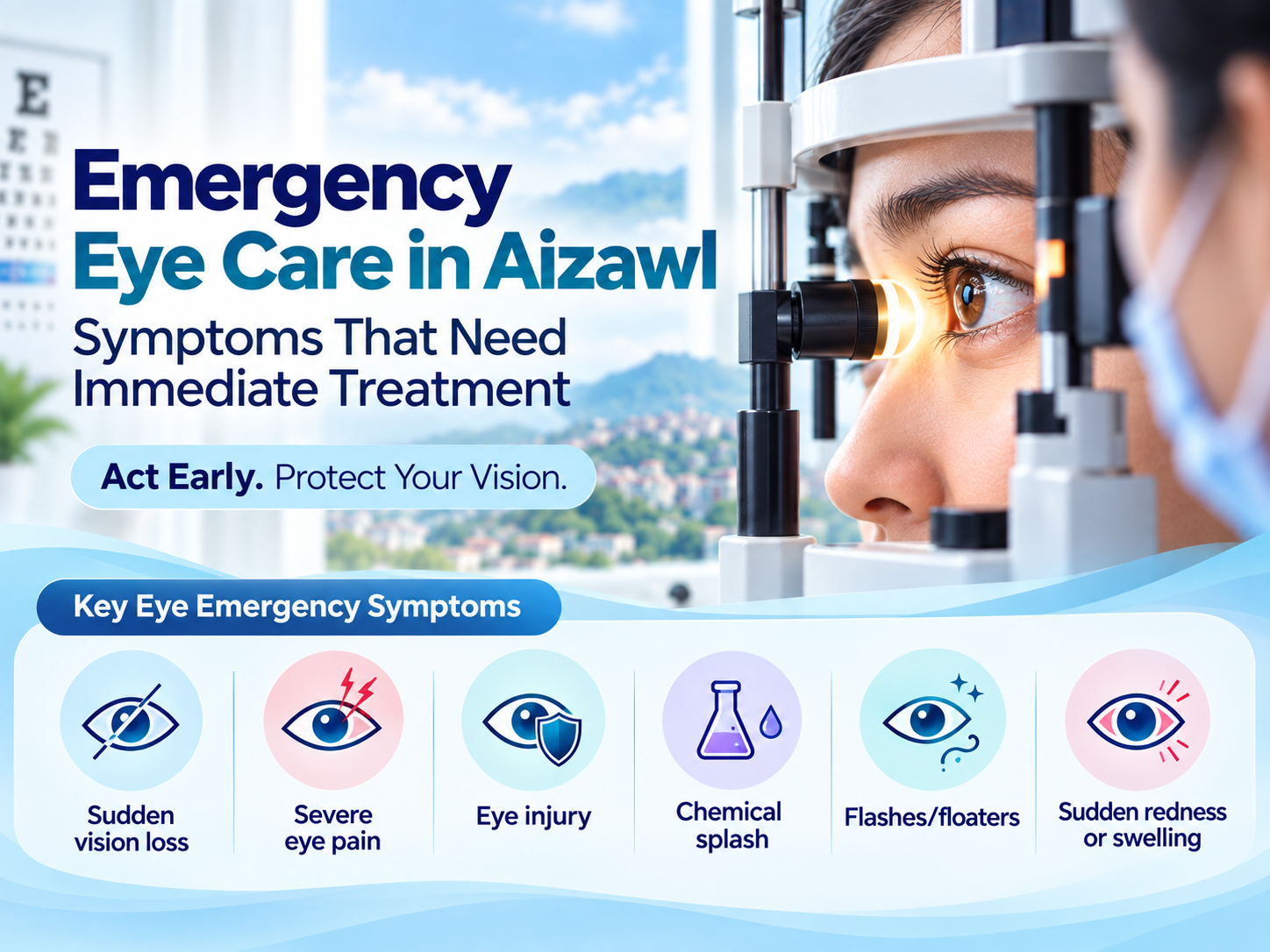
Eye problems can change quickly. A person may feel comfortable in the morning and develop pain, redness or loss of vision later in the day. Some symptoms can safely wait for a scheduled eye examination, but others may signal a condition in which early treatment is important for protecting sight. Knowing when to seek emergency eye care in Aizawl can help patients and families make a safer decision.
Sudden vision loss, a chemical splash, a penetrating injury, severe pain, a curtain-like shadow, or a painful red eye should never be ignored. These symptoms do not identify one specific disease, and it is not possible to judge their seriousness accurately at home. This guide explains common warning signs, basic first aid, what not to do, and what patients in Aizawl and across Mizoram can expect during an urgent eye examination.
If you currently have sudden loss of vision, a serious injury, chemical exposure, severe pain, or eye symptoms with weakness, facial drooping, confusion or difficulty speaking, seek the nearest appropriate emergency medical service immediately.
What is an eye emergency?
An eye emergency is a symptom or injury that may threaten vision, damage the eye, or point to a serious medical or neurological condition. The eye is delicate, and problems affecting the cornea, retina, optic nerve, eye pressure or blood supply may require assessment much sooner than a routine spectacle appointment.
Not every red or watery eye is an emergency. Mild irritation without pain or vision change may have a less urgent cause. However, pain, reduced vision, light sensitivity, trauma, recent surgery or contact-lens use can change the level of concern. When you are uncertain, it is safer to obtain professional advice than to delay because the eye “does not look too bad.”
Symptoms that need immediate emergency eye care in Aizawl
1. Sudden loss or major reduction of vision
A sudden change in vision in one or both eyes is an emergency even when it is painless. A person may describe complete darkness, a missing area, heavy blur, distorted sight, faded colours or vision that disappears and then returns.
Possible causes include a retinal problem, blockage of blood flow, optic-nerve disease, bleeding inside the eye, acute glaucoma or a neurological event. Do not wait for the vision to clear on its own, and do not drive yourself. Note the exact time the change began because timing may affect investigation and treatment.
2. New flashes, many floaters or a curtain-like shadow
Floaters may look like dots, threads, cobwebs or small shadows that move with the eyes. A few longstanding floaters can be harmless. A sudden shower of new floaters, flashes of light, peripheral blur or a dark curtain across vision can indicate a retinal tear or retinal detachment.
The National Eye Institute advises immediate assessment when new floaters appear suddenly with flashes or a dark shadow because retinal tear or detachment can be a medical emergency. Risk can be higher in people with high myopia, diabetes, an eye injury or previous cataract surgery.
3. Severe eye pain or a very painful red eye
Severe pain, especially when accompanied by redness, blurred vision, halos, headache, nausea or vomiting, requires urgent evaluation. Causes may include acute angle-closure glaucoma, corneal infection, inflammation inside the eye, injury or another condition that cannot be distinguished by appearance alone.
Do not use leftover antibiotic or steroid drops. Steroid drops can worsen certain infections and should be used only after an appropriate examination. If pain is strong enough to disturb sleep or is combined with loss of vision, go to an emergency medical facility.
4. Chemical splash in the eye
Household cleaners, lime, cement, laboratory chemicals, agricultural products and industrial substances can injure the ocular surface. Chemical exposure is a true emergency because damage may continue while the substance remains in contact with the eye.
Begin rinsing immediately with plenty of clean, gently flowing water. Do not delay irrigation while searching for a special solution or calling a clinic. Hold the eyelids open, blink during rinsing and remove contact lenses if they come out easily. Continue rinsing while arranging emergency care. Do not attempt to neutralise an acid with an alkali or an alkali with an acid.
Guidance from the American Academy of Ophthalmology’s EyeWiki emphasises that immediate, copious irrigation is the cornerstone of chemical-burn treatment and should not be delayed to identify the chemical. Bring the product container or a photograph of its label if this can be done safely.
5. A cut, puncture or object embedded in the eye
A high-speed fragment from hammering, grinding, cutting metal, construction work or an explosion can penetrate the eye even when the external wound appears small. Glass, wire, wood and sharp tools can also cause serious injury.
Do not press, rub or rinse an eye if you suspect it has been cut or punctured. Do not attempt to pull out an embedded object. Avoid putting pressure from a cloth patch over the eye. Protect it loosely from further contact and proceed to an emergency department for urgent ophthalmic assessment.
6. Blunt trauma to the eye or face
A ball, fist, fall, road accident or other blunt impact can cause bleeding, fracture, retinal injury or damage to the lens even when the eyelids are not cut. Seek urgent help for reduced vision, double vision, severe pain, an irregular pupil, blood visible inside the eye, restricted eye movement or increasing swelling.
A cold compress may be held gently over the surrounding area for a minor bruise, but do not apply pressure directly to the eyeball. A significant injury needs examination rather than home observation.
7. Contact-lens wear with pain, redness or blurred vision
Contact-lens wearers can develop corneal infection, which may progress quickly. Remove the lenses promptly if you experience unusual irritation, redness, increasing pain, light sensitivity, discharge or sudden blur. Do not put the lens back in and do not rely on redness-relief drops.
The Centers for Disease Control and Prevention advises contact-lens users with these symptoms to remove their lenses and contact an eye doctor immediately. Bring the lenses, case and solutions to the appointment if requested, but do not delay care to locate them.
8. Eye symptoms after surgery or an injection
Some mild irritation may occur after an eye procedure, but severe or increasing pain, worsening redness, sudden blur, discharge, flashes, numerous floaters or rapidly decreasing vision can indicate a complication. Contact the operating team immediately or seek emergency assessment, particularly if the procedure was recent.
Do not stop prescribed postoperative medicines unless instructed, but do not add other drops on your own. Take the discharge summary and medication list with you.
9. Sudden double vision or eye symptoms with neurological signs
New double vision can arise from an eye-muscle, nerve or neurological problem. It needs urgent evaluation when it starts suddenly or occurs with severe headache, a drooping eyelid, unequal pupils, weakness, numbness, facial drooping, confusion, imbalance or difficulty speaking.
These combined symptoms may require general emergency or stroke assessment rather than only an eye-clinic visit. Note the time of onset and use emergency medical services; do not drive yourself.
10. Eye emergencies in children
Children may be unable to describe vision loss or the exact site of pain. Seek prompt help after a chemical splash, sharp-object injury, high-speed impact, animal scratch or suspected foreign body. Warning signs include refusal to open an eye, persistent crying, strong light sensitivity, an abnormal pupil, blood, marked swelling or suddenly bumping into objects.
Do not force the eyelids open or allow the child to rub the eye. Keep medicines and cleaning products in their original containers and out of children’s reach.
Eye symptoms that are urgent even without severe pain
The seriousness of an eye condition is not always proportional to discomfort. Retinal detachment and some blood-vessel problems may initially be painless. Seek same-day advice for a new missing area in vision, sudden distortion, abrupt colour change, transient darkness, a new curtain or shadow, or a sudden increase in floaters.
People with diabetes should be particularly alert to sudden blur or new floaters because bleeding or other retinal complications may occur. Routine screening remains important even when vision feels normal; see our guide to diabetic retinopathy screening in Aizawl and Mizoram.
First aid before seeking emergency eye care in Aizawl
First aid depends on the type of emergency. The following measures are general guidance and do not replace professional assessment:
- Chemical exposure: start immediate, continuous rinsing with clean water and arrange emergency care.
- Loose surface particle: blink and allow natural tears to help. Gentle rinsing may be reasonable if there is no high-speed injury or suspected penetration.
- Embedded or penetrating object: do not remove, rinse, press or manipulate it. Protect the area from contact and seek emergency care.
- Blunt injury: avoid pressure on the eyeball. A gentle cold compress around the area may help a minor bruise, but vision change or significant impact needs examination.
- Contact-lens symptoms: remove the lenses, stop wearing them and seek prompt advice for pain, redness, light sensitivity or blur.
- Sudden vision loss or neurological signs: record the onset time and use an emergency medical service.
What not to do during an eye emergency
- Do not rub or press the injured eye.
- Do not attempt to remove an embedded object.
- Do not delay chemical irrigation while searching for medicine.
- Do not use homemade remedies, saliva, honey or unsterile liquids.
- Do not use another person’s eye drops.
- Do not self-start steroid drops.
- Do not patch an eye tightly after a possible penetrating injury.
- Do not wear contact lenses over a painful or red eye.
- Do not drive when vision is suddenly reduced or double.
- Do not eat or drink excessively when urgent surgery or sedation might be required.
What to expect from emergency eye care in Aizawl
The clinical team will ask when the symptoms began, whether one or both eyes are affected, and whether there was an injury, chemical, contact lens, operation or general-health problem. Provide the exact substance or mechanism whenever possible.
Assessment may include visual-acuity testing, pupil reactions, eye movements, slit-lamp examination, fluorescein dye, eye-pressure measurement and a dilated retinal examination. Pressure testing may be avoided when an open-globe injury is suspected. Retinal imaging, visual-field assessment, ultrasound, CT scanning or blood tests may be required depending on the findings.
The purpose is to identify the anatomical structure involved and decide whether the patient needs medicine, a procedure, surgery, imaging, observation or transfer to a facility with appropriate emergency resources.
Emergency eye care versus a routine appointment
Emergency eye care in Aizawl is intended for sudden or serious symptoms, while a routine appointment is generally suitable for gradual spectacle-power changes, longstanding mild dryness, stable eyelid symptoms or a planned screening examination. Urgent assessment is more appropriate when symptoms are sudden, severe, linked to an injury or operation, or accompanied by vision loss.
A red eye with mild itching and no pain may result from allergy, but a red eye with pain, light sensitivity or reduced vision needs quicker evaluation. Our separate article explains common causes and treatment of conjunctivitis in Aizawl.
How to prepare while travelling for urgent treatment
If possible, ask a relative or friend to accompany you. Bring current medicines, allergy information, spectacles, previous reports and details of recent surgery. For chemical exposure, bring the container or a clear photograph of the label without delaying irrigation.
Patients travelling from outside Aizawl should not postpone time-sensitive emergency care for a long journey when a nearer emergency department can provide initial assessment and stabilisation. The safest destination depends on the condition, time of day and available local services.
Preventing serious eye injuries
Many eye injuries are preventable. Wear appropriate protective goggles during grinding, welding, construction, carpentry, farming, laboratory work, chemical handling and activities that can create flying fragments. Ordinary spectacles do not provide the same protection as safety eyewear.
Store cleaning chemicals safely, read labels and avoid transferring corrosive products into drink bottles. Supervise children around sharp objects, fireworks, elastic projectiles and household chemicals. Contact-lens users should wash and dry their hands, follow replacement schedules, avoid sleeping or swimming in lenses unless specifically approved, and never rinse lenses with tap water.
Seeking emergency eye care in Aizawl
Dr. Lynapawngia Solo at Dr. Nunu Eye Hospital & Research Centre assesses eye symptoms and helps patients determine the appropriate next step. For urgent advice during available clinic hours, call +91 98620 19216.
For sudden blindness, a penetrating injury, chemical burn, severe trauma, stroke-like symptoms or another major emergency, proceed to the nearest equipped emergency department or use local emergency medical services without waiting for a routine clinic appointment.
Medical note: This article provides general information and does not diagnose an individual condition. Emergency services, opening hours and available specialist care can change. Severe or sudden symptoms require immediate assessment at an appropriate medical facility.