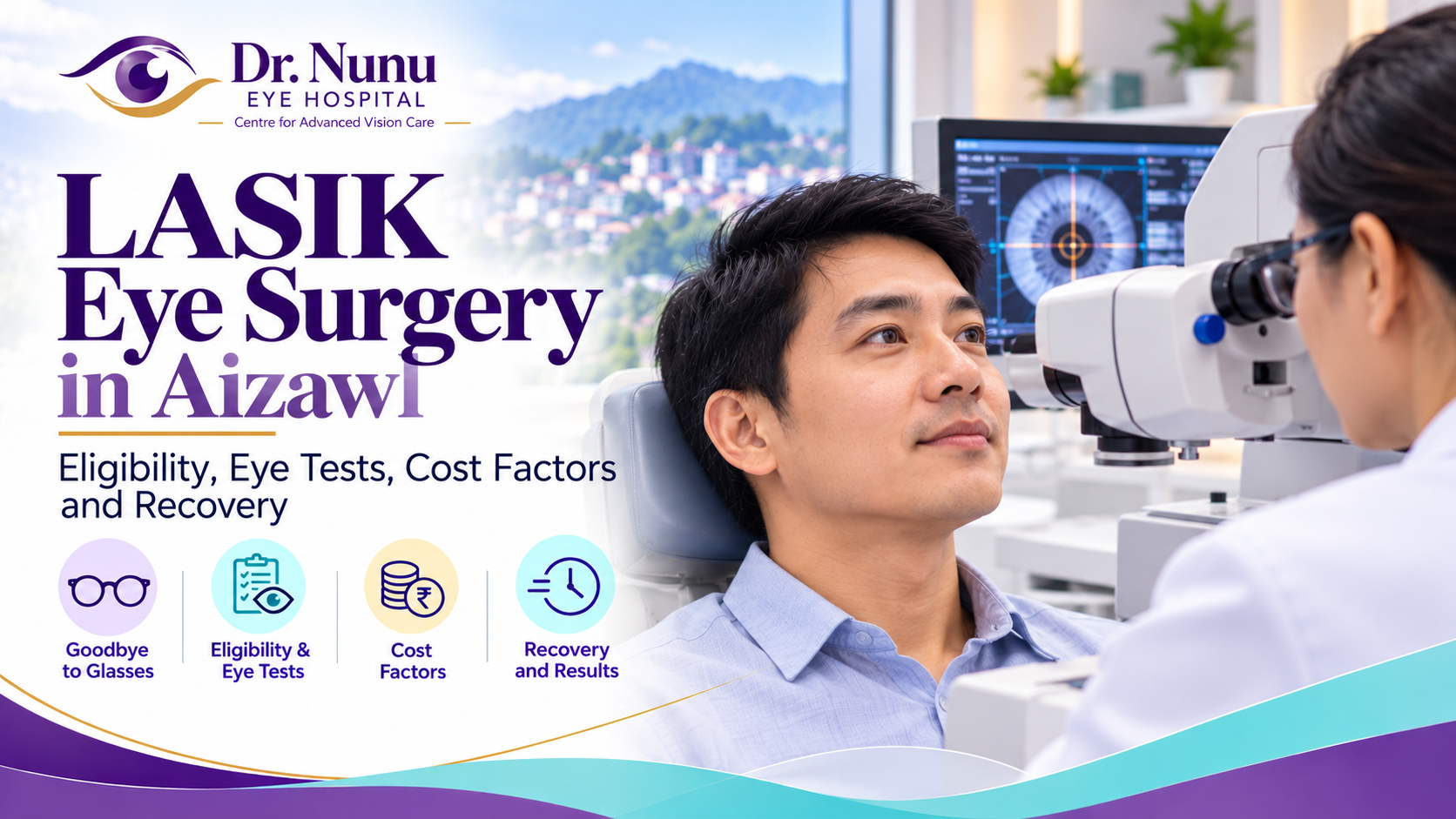
LASIK eye surgery in Aizawl is often considered by adults who want to reduce their dependence on spectacles or contact lenses. LASIK reshapes the clear front surface of the eye—the cornea—so that light focuses more accurately on the retina. It may correct short-sightedness, long-sightedness and astigmatism in appropriately selected patients.
However, LASIK is not suitable for everyone, and it cannot guarantee perfect vision or freedom from glasses for life. A safe decision begins with a comprehensive eye examination, accurate corneal measurements and a realistic discussion of benefits, alternatives and risks. This guide explains candidacy, preoperative testing, cost factors, recovery and the questions patients in Aizawl and across Mizoram should ask before choosing laser vision correction.
What is LASIK eye surgery?
LASIK stands for laser-assisted in situ keratomileusis. During the procedure, the surgeon creates a thin flap in the cornea, reshapes the underlying tissue with an excimer laser and then returns the flap to its original position. Changing the corneal curvature alters how light enters the eye and can reduce refractive error.
LASIK is an elective refractive procedure. Its purpose is usually to reduce the need for spectacles or contact lenses rather than to treat an eye disease. The National Eye Institute explains that refractive surgery changes the corneal shape and that LASIK works best when the spectacle prescription has remained stable.
Which vision problems can LASIK correct?
Myopia or short-sightedness
In myopia, distant objects look blurred because light focuses in front of the retina. LASIK can flatten the central cornea to move the focus backward toward the retina.
Hyperopia or long-sightedness
Hyperopia may cause difficulty with near work and, at higher levels or with age, distance blur. LASIK can steepen the central cornea in selected patients. Eligibility depends on the amount of hyperopia, corneal shape, age and other measurements.
Astigmatism
Astigmatism occurs when the cornea or lens has unequal curvature in different directions. Laser treatment may make corneal curvature more regular, but the amount and type of astigmatism influence whether LASIK is appropriate.
Presbyopia after age 40
LASIK does not stop presbyopia, the age-related loss of near focusing. A patient who achieves clear distance vision may still need reading glasses. Some people consider monovision, where one eye is targeted for distance and the other for near vision, but not everyone adapts comfortably. A contact-lens trial is often useful before choosing permanent monovision correction.
Who may be eligible for LASIK?
Final eligibility can be decided only after examination. Common requirements include:
- being at least 18 years old, with many surgeons preferring patients over 21;
- a spectacle or contact-lens prescription that has been stable for at least the period recommended by the surgeon;
- a refractive error within the safe treatment range of the laser platform;
- adequate corneal thickness and a regular, healthy corneal shape;
- healthy tear film and manageable dry-eye symptoms;
- no active eye infection or uncontrolled eye disease;
- general health compatible with normal healing;
- realistic expectations about visual results and possible need for glasses.
The American Academy of Ophthalmology notes that candidates need healthy, sufficiently thick corneas, generally good eye health and a prescription that has not changed significantly.
Who may not be suitable for LASIK?
LASIK may be delayed, discouraged or replaced by another option when a patient has:
- an unstable spectacle prescription;
- corneas that are thin, irregular or suspicious for keratoconus;
- significant untreated dry eye;
- active infection, inflammation or recurrent corneal herpes;
- a visually significant cataract;
- advanced or uncontrolled glaucoma;
- certain retinal problems;
- very high refractive error outside a safe corneal treatment range;
- poorly controlled diabetes or a condition that affects wound healing;
- pregnancy or breastfeeding, when vision and corneal measurements may fluctuate;
- medicines that may affect healing or cause unstable vision;
- unrealistic expectations or an occupation that restricts refractive surgery.
The U.S. Food and Drug Administration’s LASIK candidacy guidance highlights refractive instability, pregnancy, healing disorders, certain medicines and some occupations or contact sports as issues that require careful discussion.
Why a detailed LASIK evaluation matters
A brief spectacle-power test is not enough to determine LASIK safety. Two people with the same prescription may have very different corneal thickness, topography, tear quality, pupil size or retinal health. Preoperative testing is designed to answer two questions: can the refractive error be treated effectively, and can enough structurally healthy cornea be preserved?
The measurements also guide the laser treatment plan. Contact lenses can temporarily alter corneal shape, so patients are usually asked to stop wearing them before the evaluation for a period based on lens type and the surgeon’s instructions.
Eye tests before LASIK surgery in Aizawl
Medical and eye-history review
The doctor asks about prescription changes, contact-lens use, dry-eye symptoms, previous infection, injury, surgery and family eye history. Diabetes, autoimmune disease, pregnancy, allergies and current medicines are relevant because they may affect measurements or healing.
Distance and near visual acuity
Each eye is tested separately with and without correction. This establishes current visual function and helps compare the expected benefit of surgery with vision obtained using glasses.
Manifest and cycloplegic refraction
Refraction measures the degree of myopia, hyperopia and astigmatism. In some patients, dilating or cycloplegic drops are used to relax focusing and reveal the full prescription. Stable, repeatable measurements are essential for planning.
Corneal topography and tomography
Topography maps the front corneal surface. Tomography assesses the front and back surfaces and corneal thickness distribution. These tests help identify irregular astigmatism, keratoconus or patterns that could increase the risk of corneal weakening after surgery.
Corneal thickness measurement
Pachymetry measures corneal thickness. The surgeon calculates how much tissue the laser would remove and how much supporting cornea would remain. A cornea can be clear and appear healthy during a routine examination yet still be unsuitable for LASIK because of its thickness or shape.
Tear-film and dry-eye assessment
LASIK can temporarily worsen dry-eye symptoms. The examination may include tear-film stability, corneal staining, eyelid-gland assessment and symptom review. Treating dry eye and blepharitis before surgery can improve comfort and measurement reliability.
Patients with burning, fluctuating vision or chronic irritation can read our guide to dry-eye treatment in Aizawl and Mizoram.
Pupil-size measurement
Pupil size, especially in dim light, may influence the discussion about night glare, halos and treatment-zone planning. It is only one part of risk assessment and must be interpreted with corneal and refractive measurements.
Slit-lamp examination
The ophthalmologist examines the eyelids, tear film, cornea, anterior chamber, iris and lens. Active allergy, infection, inflammation, corneal scars or cataract may require treatment or a different plan.
Eye pressure, optic nerve and retina
Eye pressure and optic-nerve assessment help screen for glaucoma. A dilated examination may be needed to evaluate the lens and retina, especially in patients with high myopia, diabetes, flashes, floaters or previous retinal disease.
Preparing for a LASIK consultation
Bring your current and older spectacle prescriptions if available. Changes over time help establish stability. Bring a list of medicines, details of previous eye problems and information about your work, driving and visual priorities.
Ask the clinic how long to stop wearing contact lenses before testing. The FDA notes that contact lenses can alter corneal shape for days or weeks depending on the lens type, making measurements inaccurate if they are removed too close to the evaluation.
Avoid eye makeup on the day of detailed testing if instructed. Tell the doctor about pregnancy, breastfeeding, diabetes, autoimmune disease, severe allergies, eye rubbing and participation in contact sports.
What happens during LASIK?
The eye is numbed with anaesthetic drops. A device helps keep the eyelids open. The surgeon creates a thin corneal flap using a femtosecond laser or, in some systems, a microkeratome. The flap is lifted and an excimer laser removes a precisely calculated amount of corneal tissue. The flap is then returned to position, where it adheres without stitches.
The laser treatment itself is brief, but preparation, positioning and checks take additional time. Patients remain awake and follow instructions to look at a fixation light. Modern systems may track small eye movements, but cooperation remains important.
Does LASIK hurt?
Anaesthetic drops reduce pain during the procedure, although pressure or unusual sensations may be noticed. For several hours afterward, eyes can feel gritty, watery, burning or sensitive to light. Patients are normally advised to rest, avoid rubbing and use prescribed drops exactly as directed.
LASIK recovery: what to expect
The first day
Vision may be hazy immediately after surgery and often improves quickly. Arrange for someone to take you home; do not drive on the day of surgery. Protective shields may be provided to prevent accidental rubbing while sleeping.
The first week
Use antibiotic, anti-inflammatory and lubricating drops according to the surgeon’s schedule. Attend the early follow-up appointment even if vision feels good. Avoid eye rubbing, makeup, dusty environments and water entering the eyes until cleared.
Return to work and normal activities
Many people return to desk work relatively quickly, but timing varies with healing, symptoms and job demands. Driving should resume only after the surgeon confirms vision meets the required standard and the patient feels safe. Swimming, contact sports, heavy exercise and exposure to contaminated water may need to be avoided for longer.
Vision stabilisation
Fluctuation, glare, halos and dryness can occur during early recovery. Final healing and visual stability may take weeks to several months. The National Eye Institute notes that the eye may take two to three months to finish healing and that follow-up visits are important.
Possible benefits of LASIK
- reduced dependence on spectacles or contact lenses;
- greater convenience for sports and daily activities;
- rapid visual recovery for many suitable patients;
- correction of myopia, hyperopia or astigmatism within appropriate ranges.
Results vary. Some patients still need glasses for night driving, detailed tasks or residual refractive error. Reading glasses are commonly needed with age because LASIK does not prevent presbyopia.
Risks and side effects to discuss
LASIK is surgery and therefore has risks. Possible effects include:
- dryness, burning or fluctuating vision;
- glare, halos, starbursts or reduced night-vision quality;
- under-correction, over-correction or residual astigmatism;
- continued need for spectacles;
- infection or inflammation;
- flap displacement, folds or related complications;
- corneal haze or delayed healing;
- corneal weakening or ectasia in susceptible eyes;
- reduced contrast sensitivity, double vision or persistent visual symptoms;
- rare loss of best-corrected vision.
The FDA’s LASIK risk information emphasizes that some patients experience glare, halos, double vision or difficulty seeing in low contrast even when their eye-chart result is good. Personal priorities—especially night driving and occupation—should be part of informed consent.
Cost factors for LASIK eye surgery in Aizawl
LASIK cost varies because “laser eye surgery” is not a single identical package. Patients should request a written explanation of what is included rather than comparing only an advertised headline price.
Type of procedure and technology
Conventional LASIK, wavefront-guided or topography-guided treatment, femtosecond flap creation and alternative procedures may have different costs. The most expensive option is not automatically the best; suitability and safety should guide the recommendation.
Preoperative testing
Comprehensive refraction, topography, tomography, pachymetry, dry-eye evaluation and retinal assessment may be included or billed separately. Ask which tests are necessary and whether repeat measurements are covered.
Surgeon and facility fees
The quoted price may include the surgeon, laser facility, medicines, protective shields and follow-up visits—or these may be separate. Confirm whether the quotation covers one eye or both eyes.
Follow-up and enhancement policy
Ask how many postoperative visits are included, how long follow-up continues and what happens if residual power remains. Enhancement surgery is not always advisable and may have eligibility rules, waiting periods or additional costs.
Travel and time away from work
Patients travelling from outside Aizawl should account for transport, accommodation and the need to return for follow-up. Do not plan surgery without arranging a safe journey home and access to urgent advice if symptoms develop.
Insurance and financing
Refractive surgery is often considered elective and may not be covered by standard insurance. Verify coverage directly with the insurer and clinic. Read financing terms carefully and do not allow a limited-time discount to replace medical decision-making.
LASIK alternatives
If LASIK is unsuitable, alternatives may include:
- spectacles;
- contact lenses;
- photorefractive keratectomy (PRK);
- small-incision lenticule extraction (SMILE), where available and suitable;
- phakic intraocular lenses for selected higher refractive errors;
- refractive lens exchange in carefully chosen patients;
- continued monitoring until prescription stability is established.
Each option has distinct benefits, recovery patterns and risks. Cataract surgery may be more appropriate than corneal laser treatment when a cataract is the main cause of visual decline.
Questions to ask before choosing LASIK
- Is my prescription stable and within a safe treatment range?
- Are my corneal shape and thickness suitable?
- Do I have dry eye, keratoconus risk, cataract, glaucoma or retinal disease?
- What procedure is recommended and why?
- What result is realistic for my eyes?
- Could I still need distance or reading glasses?
- What are my personal risks of glare, halos or dry eye?
- What does the quoted cost include?
- Who provides postoperative care and emergency advice?
- What alternative is safest if LASIK is unsuitable?
Warning signs after LASIK
Contact the treating surgeon urgently for worsening pain, increasing redness, sudden vision reduction, discharge, significant light sensitivity, trauma to the eye or a displaced-feeling flap. Do not wait for a routine follow-up when symptoms are severe or rapidly changing.
For general urgent symptoms, see our article on emergency eye care in Aizawl.
Frequently asked questions
Will LASIK remove spectacles permanently?
LASIK may greatly reduce spectacle dependence, but it cannot guarantee that glasses will never be needed. Eyes can change with age, and most people eventually develop presbyopia and need near correction.
What is the best age for LASIK?
There is no single best age. Patients must be adults and have stable vision, healthy corneas and appropriate expectations. Eligibility becomes more complex as presbyopia and cataract risk increase.
Can LASIK correct very high power?
Sometimes, but safety depends on prescription, corneal thickness, corneal shape and predicted remaining tissue. A phakic lens or another option may be safer for some high prescriptions.
Can LASIK be done with dry eye?
Mild dry eye may be treated and stabilised before reassessment. Significant or uncontrolled dry eye may make LASIK unsuitable because surgery can worsen symptoms.
When can I use screens after LASIK?
Follow the surgeon’s instructions. Screens do not normally damage the flap, but reduced blinking can worsen dryness. Resume gradually, take breaks and use prescribed lubricants.
Can I fly after LASIK?
Air travel may be possible relatively soon, but cabin dryness and follow-up timing matter. Ask the surgeon before booking travel and make sure postoperative review will not be missed.
LASIK eligibility consultation in Aizawl
Anyone considering laser vision correction should begin with a comprehensive examination rather than assuming LASIK is the correct procedure. Dr. Lynapawngia Solo at Dr. Nunu Eye Hospital & Research Centre can assess refractive error, eye health and the need for specialised corneal testing, then discuss appropriate next steps or referral where required.
To enquire about a LASIK eligibility assessment in Aizawl, call +91 98620 19216. Bring current spectacles, previous prescriptions, contact-lens information and a list of medicines. Ask in advance how long contact lenses should be removed before corneal measurements.
Medical note: This article provides general education and does not confirm that LASIK is suitable for any individual. Refractive surgery is elective and carries risks. A complete examination and informed discussion with a qualified ophthalmologist are essential before treatment.