

Clear vision. Compassionate care. Better tomorrow.Call: +91 98620 19216
☎ Call now

Tag: retina specialist Aizawl

  • Retina Specialist in Aizawl: Symptoms, Retina Tests and Treatment

    Retina Specialist in Aizawl: Symptoms, Retina Tests and Treatment

    If you are searching for a retina specialist in Aizawl, you may be worried about sudden floaters, flashes of light, blurred vision, distortion, diabetes-related eye changes, or a shadow in your sight. The retina is the light-sensitive layer at the back of the eye. Because retinal problems can sometimes progress without pain, and some can threaten sight quickly, timely examination is important.

    This guide explains the symptoms that may need retinal evaluation, the tests an eye doctor may recommend, common retinal conditions, and available treatment approaches. It is written for patients and families in Aizawl and across Mizoram who want to know when a routine appointment is appropriate and when urgent care is necessary.

    What Does a Retina Specialist in Aizawl Do?

    A retina specialist is an ophthalmologist with focused expertise in diseases affecting the retina, macula and vitreous gel inside the eye. The retina receives light and converts it into signals that travel through the optic nerve to the brain. The macula is the small central part of the retina responsible for reading, recognising faces and seeing fine detail.

    Retinal diseases can affect central vision, side vision, colour perception or the clarity of sight. A retinal examination may include dilation, retinal imaging and scans that reveal changes not visible during a simple vision test. Your eye doctor may monitor a stable condition, recommend medical treatment, or arrange urgent intervention when the retina is at risk.

    When Should You See a Retina Specialist in Aizawl?

    Book an eye examination if you notice a new or unexplained change in vision. Some symptoms develop gradually, while others appear suddenly. Important symptoms include:

    • new floaters, cobwebs, dots or strands in your vision;
    • flashes of light, especially at the side of your vision;
    • a curtain, veil or dark shadow moving across the visual field;
    • sudden loss or severe blurring of vision;
    • straight lines appearing bent, wavy or broken;
    • a dark or empty area in the centre of vision;
    • difficulty reading or recognising faces despite updated glasses;
    • vision changes in a person with diabetes, high blood pressure or high myopia;
    • reduced vision after an eye injury or recent eye surgery.

    Even when symptoms are mild, an examination can help distinguish a harmless age-related vitreous change from a retinal tear or another condition that needs treatment.

    When a Retina Specialist in Aizawl Is Urgently Needed

    A sudden shower of floaters, repeated light flashes, a curtain-like shadow, or rapid loss of vision can be warning signs of a retinal tear or retinal detachment. These symptoms should not wait for a routine appointment. Seek urgent eye care the same day. Early treatment may prevent a small tear from progressing and can improve the chance of preserving useful vision.

    Sudden painless vision loss can also occur because of bleeding, blockage of a retinal blood vessel or other serious causes. Severe eye injury, a chemical splash, or vision loss with neurological symptoms also requires emergency assessment. Read our guide to emergency eye care in Aizawl for additional warning signs.

    Common Conditions Evaluated by a Retina Specialist in Aizawl

    Diabetic retinopathy and diabetic macular oedema

    High blood sugar can damage tiny retinal blood vessels. Early diabetic retinopathy may cause no noticeable symptoms, which is why people with diabetes need regular dilated eye examinations. More advanced disease can cause leakage, swelling in the macula, bleeding or the growth of fragile new vessels. Learn more in our local guide to diabetic retinopathy screening in Aizawl.

    Retinal tears and retinal detachment

    As the vitreous gel changes with age, it can pull away from the retina. This is often harmless, but sometimes it creates a tear. Fluid can then pass through the tear and separate the retina from the wall of the eye. Sudden flashes, new floaters and a curtain or shadow are classic warning symptoms. Our article about flashes and floaters in Aizawl explains these signs in more detail.

    Macular disorders

    The macula may be affected by age-related macular degeneration, macular holes, epiretinal membranes or swelling. People may notice distorted lines, difficulty reading, faded colours or a blurred central patch. An OCT scan can provide detailed cross-sectional images of the macula and help the doctor assess thickness, fluid and structural change.

    Retinal vein or artery occlusion

    A blocked retinal blood vessel can cause sudden or gradual visual loss. Risk factors may include high blood pressure, diabetes, high cholesterol, glaucoma and certain blood disorders. The doctor may recommend systemic evaluation as well as eye treatment because vascular health and eye health are closely connected.

    Vitreous haemorrhage

    Bleeding into the vitreous may look like haze, smoke, dark spots or a red tint. Causes include diabetic retinopathy, a retinal tear, trauma and abnormal blood vessels. If blood prevents a clear view of the retina, ultrasound may help detect a retinal detachment or other structural problem.

    Who Should Book a Retina Specialist in Aizawl?

    Anyone can develop a retinal problem, but risk is higher in people with diabetes, uncontrolled blood pressure, high cholesterol, high myopia, previous eye surgery, significant eye trauma, a family or personal history of retinal detachment, or increasing age. Pregnancy can also influence diabetic eye disease, so women with diabetes should ask their doctor about the right examination schedule.

    If you have no symptoms but belong to a higher-risk group, do not wait for vision to deteriorate. Preventive retinal checks can identify changes at a stage when monitoring or treatment may be more effective.

    Tests a Retina Specialist in Aizawl May Recommend

    The tests you need depend on your symptoms and medical history. A retina specialist in Aizawl may recommend some of the following:

    Visual acuity and refraction

    A standard eye chart measures clarity of vision at different distances. Refraction determines whether glasses can improve the blur. If vision remains reduced despite an accurate prescription, the doctor looks for other causes.

    Dilated retinal examination

    Eye drops widen the pupil so the doctor can examine the vitreous, optic disc, macula and peripheral retina. Bright lights are necessary to see fine details. Your vision may be blurred and sensitive to light for several hours afterward, so bring sunglasses and arrange help with travel if required.

    Optical coherence tomography (OCT)

    OCT is a quick, non-contact scan that produces detailed layers of the retina. It is especially useful for macular swelling, diabetic macular oedema, macular holes, epiretinal membranes and age-related changes. Repeat scans allow the doctor to compare progress over time.

    Fundus photography

    Retinal photographs document the appearance of the retina and optic disc. They can help monitor diabetic changes, blood vessel abnormalities and other findings. Photography supports—but does not always replace—a complete dilated examination.

    Ocular ultrasound

    When cataract, blood or another opacity blocks the view inside the eye, a B-scan ultrasound can show the outline of the retina and vitreous. It may help identify detachment, bleeding or other changes.

    Fluorescein angiography when indicated

    In selected cases, angiography helps map blood circulation, leakage and abnormal vessels in the retina. The doctor will explain why it is needed, what it involves and any precautions before arranging the test.

    What Happens at a Retina Specialist Appointment?

    Bring your current glasses, a list of medicines, previous eye reports, and details of diabetes, blood pressure or other medical conditions. Tell the doctor when the symptom started, whether it affects one eye or both, and whether it is constant or intermittent.

    The visit usually begins with a vision check and medical history. Drops may be used to dilate the pupils. Depending on the findings, imaging or additional tests may be completed. The doctor should explain the diagnosis, whether observation is safe, how urgently treatment is needed, and what warning symptoms require immediate return.

    Treatment From a Retina Specialist in Aizawl

    Treatment is tailored to the diagnosis and severity. Not every retinal condition requires an operation. Options may include:

    • Observation and repeat imaging for stable findings that do not currently threaten vision;
    • Control of diabetes, blood pressure and cholesterol in partnership with your physician;
    • Laser treatment for selected retinal tears or vascular retinal diseases;
    • Intravitreal injections for certain types of macular swelling, diabetic eye disease or abnormal blood vessel growth;
    • Vitrectomy or retinal surgery for some detachments, non-clearing bleeding, traction or macular disorders;
    • Referral to an appropriate surgical centre when specialised intervention is required.

    The best treatment depends on examination findings. Online information cannot determine which option is right for an individual eye.

    Why Seeing a Retina Specialist in Aizawl Early Matters

    Many retinal disorders are painless. A person may assume that changing glasses will solve the problem, but glasses cannot correct retinal damage. Early diagnosis may allow treatment before permanent loss becomes extensive. The National Eye Institute explains that diabetic retinopathy can begin without symptoms, reinforcing the value of regular dilated eye examinations for people with diabetes.

    For a broader baseline assessment, see our guide to a comprehensive eye check-up in Aizawl.

    How to Prepare for a Retina Specialist in Aizawl

    • Write down your symptoms and when they began.
    • Bring diabetes and blood pressure records if available.
    • Carry previous prescriptions, OCT scans or retinal photographs.
    • Expect possible pupil dilation and temporary light sensitivity.
    • Bring sunglasses and consider arranging someone to accompany you.
    • Do not delay urgent symptoms while collecting records.

    Retina Specialist in Aizawl for Older Adults

    Age-related changes in the vitreous and retina become more common over time. New floaters may occur when the vitreous separates naturally from the retina, but the same symptoms can accompany a tear. Older adults should report a sudden increase in floaters, light flashes, distortion or a missing area of vision instead of assuming that the change is a normal part of ageing.

    Cataract can also cause gradual blur and glare, while macular or retinal disease may affect central detail. A dilated examination helps the ophthalmologist distinguish these causes and recommend the correct next step. Regular reviews are particularly important when one eye already has reduced vision or when a retinal condition has previously required treatment.

    Travelling to a Retina Specialist in Aizawl From Other Parts of Mizoram

    Patients travelling from outside Aizawl should bring previous OCT scans, retinal photographs, prescriptions and medical reports whenever possible. Carry a complete list of medicines and note any allergies. People with diabetes should bring recent blood-sugar records and details of their treating physician.

    Because pupil dilation can blur near vision and increase light sensitivity, arrange transport or an accompanying adult when possible. If symptoms suggest retinal detachment—such as a curtain, rapid vision loss, flashes or a sudden shower of floaters—do not postpone care simply to organise every record. Urgent assessment is more important.

    Frequently Asked Questions About a Retina Specialist in Aizawl

    Are floaters always dangerous?

    Many long-standing floaters are harmless. A sudden increase, especially with flashes, a dark curtain or reduced vision, needs urgent dilated examination because it may indicate a retinal tear or detachment.

    Can diabetic retinopathy occur when vision feels normal?

    Yes. Early diabetic retinopathy may not change day-to-day vision. Regular screening is important even when you can read clearly and have no eye pain.

    Is an OCT scan painful?

    No. OCT is non-contact and usually takes only a few minutes. You look at a target while the machine captures detailed retinal images.

    Will I need treatment at the first visit?

    That depends on the diagnosis. Some conditions require monitoring, while a tear, detachment or rapidly progressing vascular problem may need prompt treatment or referral.

    How often should people with diabetes have a retinal examination?

    The interval depends on the type and duration of diabetes, pregnancy status, current retinal findings and medical control. Your ophthalmologist and physician can recommend a personalised schedule.

    Book an Appointment With a Retina Specialist in Aizawl

    If you have flashes, new floaters, distortion, unexplained blur, diabetes-related eye concerns or a sudden change in sight, arrange a retinal evaluation at Dr. Nunu Eye Hospital & Research Centre in Aizawl. For appointments, call +91 98620 19216.

    This article is for general education and does not replace an examination. Sudden vision loss, a curtain or shadow, a shower of floaters, repeated flashes or eye trauma requires urgent professional assessment.
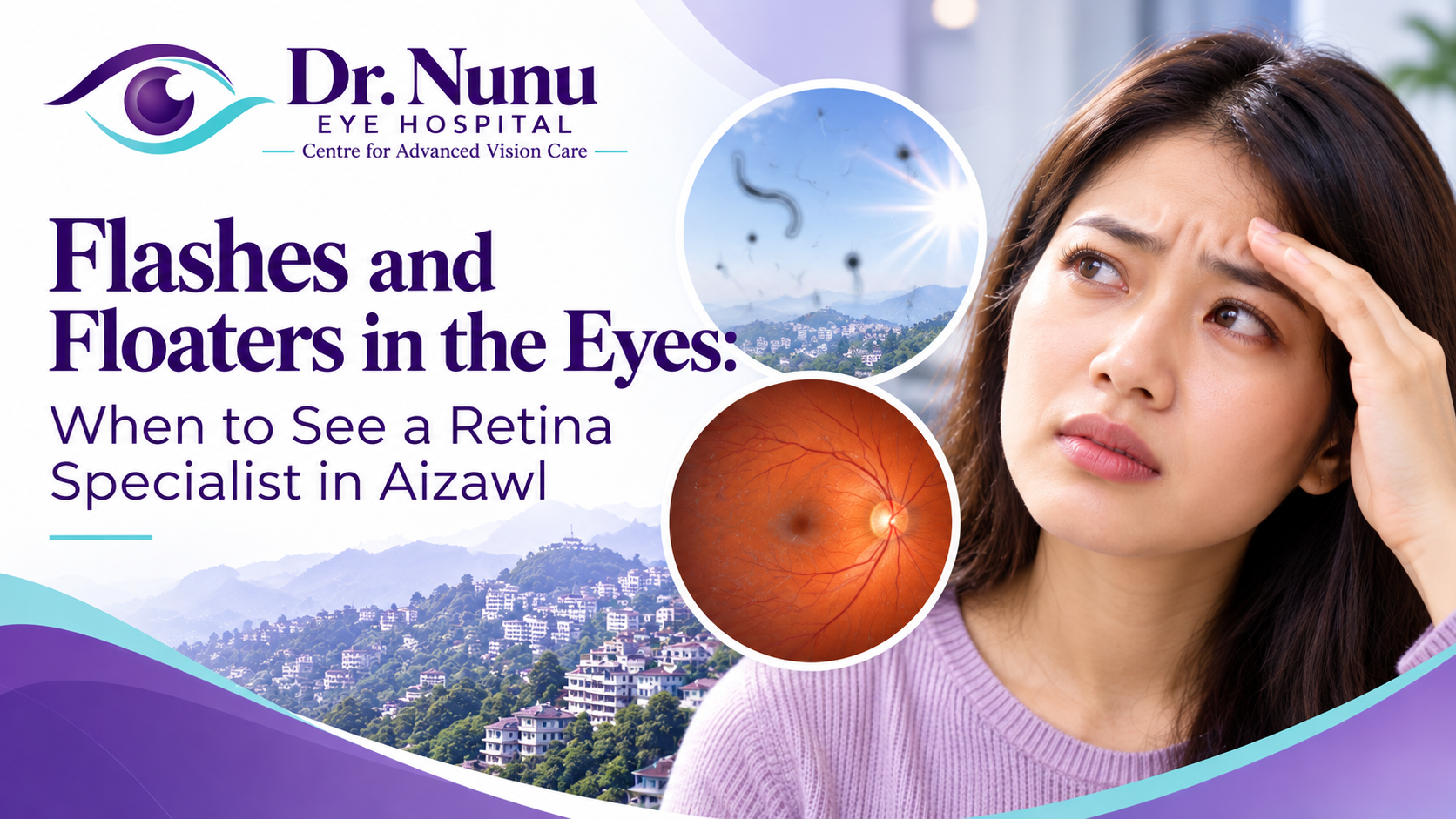
  • Flashes and Floaters in the Eyes: When to See a Retina Specialist in Aizawl

    Flashes and Floaters in the Eyes: When to See a Retina Specialist in Aizawl

    Flashes and floaters in the eyes are common visual symptoms, but a sudden change can sometimes be a warning sign of a retinal tear or retinal detachment. Many people describe floaters as moving dots, threads, cobwebs or small shadows. Flashes may look like brief sparks, lightning streaks or camera flashes at the edge of vision.

    Most long-standing floaters are harmless. However, new symptoms—especially a sudden shower of floaters, repeated flashes, blurred vision or a dark curtain across the sight—need urgent assessment. If you are experiencing these symptoms in Aizawl or elsewhere in Mizoram, do not wait for them to settle on their own. A prompt dilated retinal examination can help protect vision.

    This guide explains why flashes and floaters occur, which symptoms require immediate care, what a retina specialist checks and what treatment may be needed.

    What are eye floaters?

    Floaters are shapes that appear to drift through your field of vision. They may look like:

    • small black or grey dots;
    • threads or wavy lines;
    • rings, circles or specks;
    • cobweb-like shadows;
    • a cluster of tiny spots.

    They often move when the eyes move and seem to slip away when you try to look directly at them. Floaters are usually easier to notice against a bright, plain background such as a white wall, a computer screen or a clear sky.

    The eye is filled with a transparent gel called the vitreous. With age, this gel gradually becomes more liquid and develops tiny clumps or strands. These structures cast shadows on the retina—the light-sensitive tissue at the back of the eye—and the shadows are perceived as floaters.

    What are flashes of light in the eyes?

    Flashes occur when the retina is mechanically stimulated. As the vitreous gel changes or pulls on the retina, a person may see brief streaks or sparks even though no external light is present. They are often more noticeable in a dark room or during eye movement.

    Some people describe flashes as lightning at the side of their vision. Others report flickering, stars or brief arcs of light. Flashes caused by vitreous traction are different from the shimmering zigzag patterns that may accompany migraine, but symptoms can overlap. A first episode or an unusual visual disturbance should be assessed rather than self-diagnosed.

    Why do flashes and floaters happen?

    Normal age-related vitreous changes

    The most common cause is age-related change in the vitreous. As the gel becomes more liquid, it can separate from the retina. This is called a posterior vitreous detachment, or PVD. It becomes more common with age and may cause a sudden increase in floaters and flashes.

    A PVD itself often does not require treatment. The important concern is that the separating vitreous can occasionally pull hard enough to create a retinal tear. Fluid may then pass through the tear and lift the retina away from the wall of the eye, causing a retinal detachment.

    Retinal tear or retinal detachment

    A retinal tear may not cause pain. Its warning signs can be new flashes, many new floaters, a shower of dark dots or a change in vision. If a detachment develops, a shadow or curtain may spread from the side toward the centre of vision.

    The National Eye Institute advises immediate evaluation when many new floaters appear suddenly, especially with flashes, a dark shadow or a blurry area. Retinal tear and detachment are medical emergencies because delayed treatment can lead to permanent vision loss.

    Short-sightedness

    People with moderate or high myopia may develop vitreous changes earlier and can have a higher risk of peripheral retinal weakness, tears or detachment. A person who wears strong minus-powered spectacles should be particularly careful about a sudden change in flashes or floaters.

    Eye surgery or injury

    New floaters after cataract surgery, another eye operation or an eye injury require professional assessment. Trauma can cause bleeding, inflammation or damage to the retina even when the outside of the eye appears normal.

    Inflammation, infection or bleeding

    Inflammation inside the eye, called uveitis, can create floaters and may be accompanied by redness, pain or sensitivity to light. Diabetes and other retinal blood-vessel conditions can cause bleeding into the vitreous, producing dots, haze, cobwebs or a sudden reduction in sight.

    When should you see a retina specialist in Aizawl?

    Seek an urgent eye examination if you notice any of the following:

    • a sudden onset of floaters for the first time;
    • a rapid increase in the number or size of floaters;
    • new flashes of light in one eye;
    • a shower of black dots, specks or cobwebs;
    • a dark curtain, veil or shadow moving across vision;
    • loss of side vision;
    • sudden blurred or reduced vision;
    • flashes or floaters after an eye injury or eye surgery;
    • symptoms accompanied by eye pain or marked redness.

    A dark curtain, sudden loss of vision or rapidly expanding shadow should be treated as an emergency. Contact an ophthalmologist or go to the nearest emergency facility without delay. Do not drive yourself if your vision is impaired.

    For additional warning signs, see our guide to emergency eye care in Aizawl.

    Are long-standing floaters dangerous?

    One or two floaters that have remained unchanged for months or years, without flashes or loss of vision, are commonly harmless. The brain may gradually learn to ignore them, so they become less noticeable. Nevertheless, an eye examination is advisable if they have never been assessed or if you have risk factors such as high myopia, diabetes, previous surgery, trauma or a family history of retinal detachment.

    The key issue is change. Even a person who has had harmless floaters for years should seek prompt care if the number suddenly increases or new flashes, shadows or blurred vision appear.

    Who has a higher risk of retinal tears and detachment?

    Urgent assessment is particularly important for people who:

    • are very short-sighted;
    • are middle-aged or older;
    • have undergone cataract or other eye surgery;
    • have experienced significant eye trauma;
    • have had a retinal tear or detachment in the other eye;
    • have a family history of retinal detachment;
    • have known weak areas in the retina;
    • have diabetes or another retinal blood-vessel disorder.

    The American Academy of Ophthalmology identifies sudden flashes, many new floaters, a side-vision shadow and a grey curtain as early warning signs of retinal detachment that require immediate ophthalmic care.

    What happens during a retina examination?

    Symptom and risk review

    The doctor will ask when the symptoms started, whether they affect one or both eyes and whether they are changing. Describe the exact appearance of flashes and floaters, any missing area of vision, recent injury or surgery and relevant conditions such as diabetes or high myopia.

    Visual-acuity and pupil testing

    Each eye is tested separately. The doctor may also examine pupil reactions because an abnormal response can indicate significant retinal or optic-nerve dysfunction.

    Dilated retinal examination

    Dilating drops widen the pupil so the ophthalmologist can inspect the vitreous, retina and optic nerve. Special lenses and bright illumination are used to examine the central and peripheral retina for tears, holes, bleeding or detachment. Gentle pressure around the eyelid may sometimes be required to view the far retinal periphery.

    Dilating drops can cause temporary glare, light sensitivity and blurred near vision for several hours. Bring sunglasses and consider arranging transport, particularly if your vision is already affected.

    Additional tests

    Optical coherence tomography, or OCT, may be used when the macula needs detailed imaging. Retinal photographs can document findings. If the doctor cannot see the retina clearly because of dense bleeding or another obstruction, an eye ultrasound may be required. The tests selected depend on the examination findings.

    How are flashes and floaters treated?

    Treatment depends entirely on the cause.

    Posterior vitreous detachment without a retinal tear

    If the retina is intact, treatment is often unnecessary. Flashes commonly settle as the vitreous stops pulling, while floaters may persist but become less distracting. The doctor may recommend follow-up because a tear can occasionally develop after the first examination. Return immediately if symptoms worsen.

    Retinal tear

    A retinal tear may be sealed with laser treatment or cryotherapy to create a scar around the break and reduce the chance of fluid passing underneath the retina. The procedure and timing depend on the tear’s location, appearance and associated risk.

    Retinal detachment

    A detached retina usually requires surgery. Options may include pneumatic retinopexy, scleral buckle surgery or vitrectomy. The appropriate method depends on the type and extent of detachment, the position of the retinal breaks and the condition of the lens and vitreous.

    Early treatment generally offers a better opportunity to preserve vision, particularly before the central retina is affected. This is why a curtain-like shadow or sudden visual-field loss must not be ignored.

    Inflammation, bleeding or another retinal condition

    When floaters result from uveitis, infection, diabetic retinal disease or bleeding, the underlying condition must be treated. The ophthalmologist may coordinate care with a physician when diabetes, blood pressure, autoimmune disease or another systemic condition contributes.

    Can eye drops or home remedies remove floaters?

    No routine eye drop or home remedy dissolves age-related vitreous floaters. Hydration, rest or nutritional supplements do not repair a retinal tear. Moving the eyes may temporarily shift a floater away from the centre of vision, but it does not address the cause.

    Do not massage or press the eye, and do not delay an examination while trying home treatments when symptoms are new. Persistent floaters that severely interfere with daily life can occasionally be treated surgically, but vitrectomy carries meaningful risks and is not recommended simply because a small floater is annoying. The risks and benefits require careful discussion with an ophthalmologist.

    Flashes, floaters and migraine: what is the difference?

    Migraine aura often produces shimmering zigzags, coloured patterns or an expanding bright area that affects both eyes, even if it seems stronger on one side. It commonly develops over several minutes and resolves within an hour, sometimes followed by headache.

    Vitreous or retinal flashes are often brief, lightning-like streaks at the edge of vision and may affect one eye. These descriptions are not reliable enough for self-diagnosis. A first episode, a change from your usual migraine pattern or any associated vision loss should be evaluated urgently.

    Practical steps if symptoms begin in Aizawl or elsewhere in Mizoram

    1. Cover one eye at a time. This can help identify which eye is affected, but do not delay care.
    2. Note the time of onset. Tell the doctor whether symptoms appeared suddenly or gradually.
    3. Check for a shadow. Without repeatedly testing or straining, notice whether any part of the side or central vision is missing.
    4. Avoid driving if vision is affected. Ask someone to accompany you.
    5. Seek urgent ophthalmic assessment. Clearly state that you have sudden flashes, new floaters, a curtain or reduced vision.

    People travelling from other parts of Mizoram should not postpone emergency evaluation solely to reach a preferred clinic. If there is sudden vision loss or a curtain-like shadow, attend the nearest facility capable of urgent eye assessment.

    Frequently asked questions

    Do floaters always mean retinal detachment?

    No. Most floaters result from common vitreous changes. However, symptoms alone cannot reliably rule out a retinal tear, particularly when floaters are sudden, numerous or accompanied by flashes or a shadow.

    Is retinal detachment painful?

    It is often painless. The absence of pain does not make sudden flashes, floaters or a curtain safe to ignore.

    Can a routine spectacle test detect a retinal tear?

    A vision or refraction test alone is not enough. The peripheral retina generally needs examination through a dilated pupil by an eye-care professional with appropriate equipment.

    How quickly should new flashes and floaters be checked?

    Sudden symptoms should be assessed urgently, ideally the same day or as directed by an ophthalmologist. A curtain, new field loss or sudden reduction in sight requires immediate emergency care.

    Will floaters disappear?

    They may not physically disappear, but many become less noticeable with time. Persistent symptoms still need reassessment if they suddenly change.

    Can children experience flashes and floaters?

    Yes, although age-related PVD is less common in children. Trauma, inflammation, high myopia and retinal conditions can cause symptoms. A child reporting new flashes, spots or missing vision should be examined promptly.

    Book an urgent retinal examination in Aizawl

    If you notice sudden flashes and floaters in Aizawl, particularly with blurred vision, a shadow or a curtain-like effect, arrange urgent assessment. Dr. Lynapawngia Solo at Dr. Nunu Eye Hospital & Research Centre can evaluate the retina and advise whether monitoring, laser treatment, surgery or referral is required.

    Call +91 98620 19216 and clearly describe sudden or worsening symptoms so the clinic can advise on urgency. If you cannot promptly reach the clinic and vision is suddenly reduced, go to the nearest emergency facility.

    Medical note: This article provides general education and does not replace an examination. Sudden flashes, a shower of new floaters, a dark curtain or sudden vision loss can represent a retinal emergency. Seek urgent professional care.